

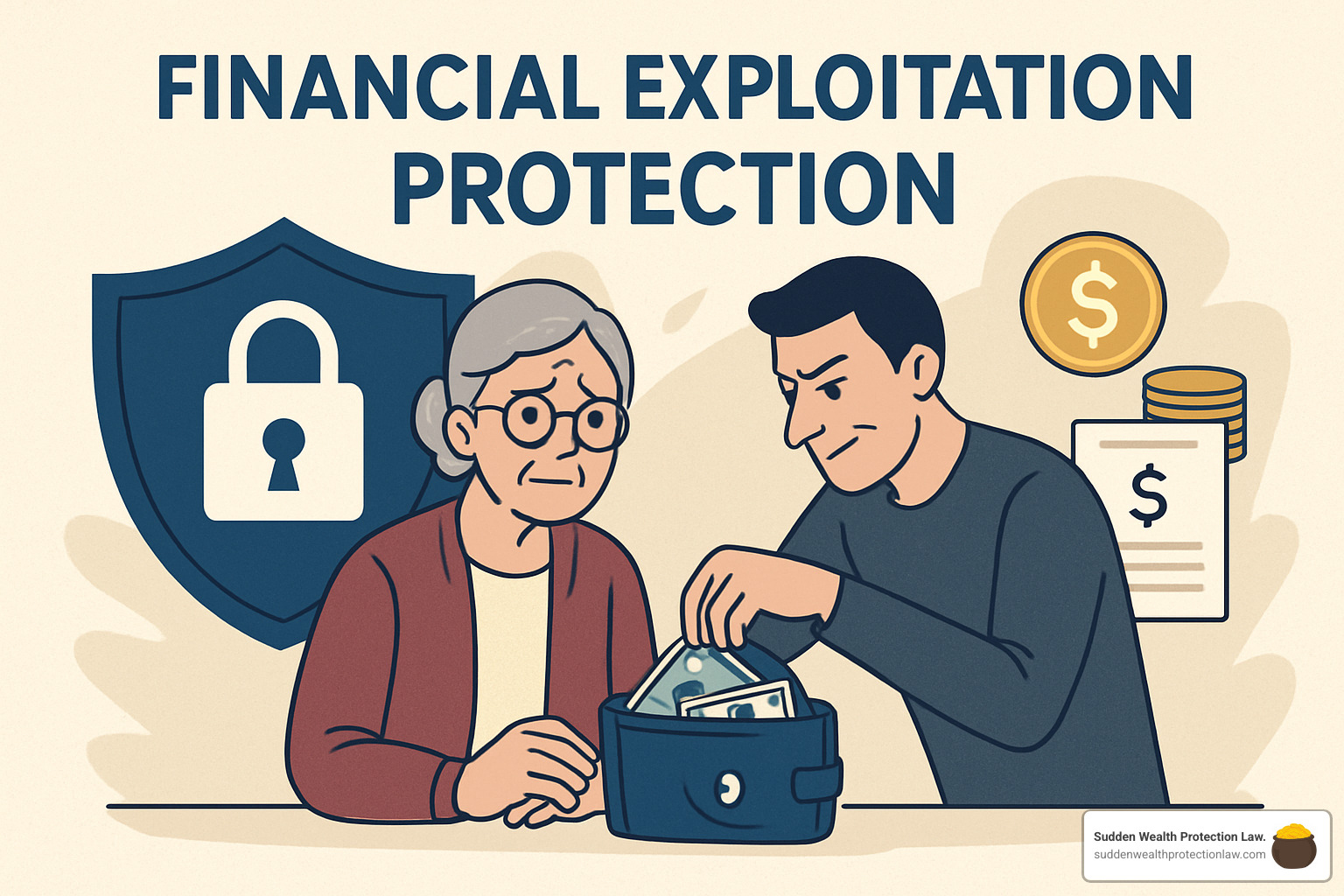
Financial Exploitation Protection refers to the measures and legal safeguards designed to prevent the illegal or improper use of an elderly or vulnerable adult’s funds, property, or assets by another individual. This protection is increasingly critical as elder financial abuse has become a widespread problem in the United States.
Quick Guide to Financial Exploitation Protection:
- Definition: Legal safeguards against misuse of vulnerable adults’ assets
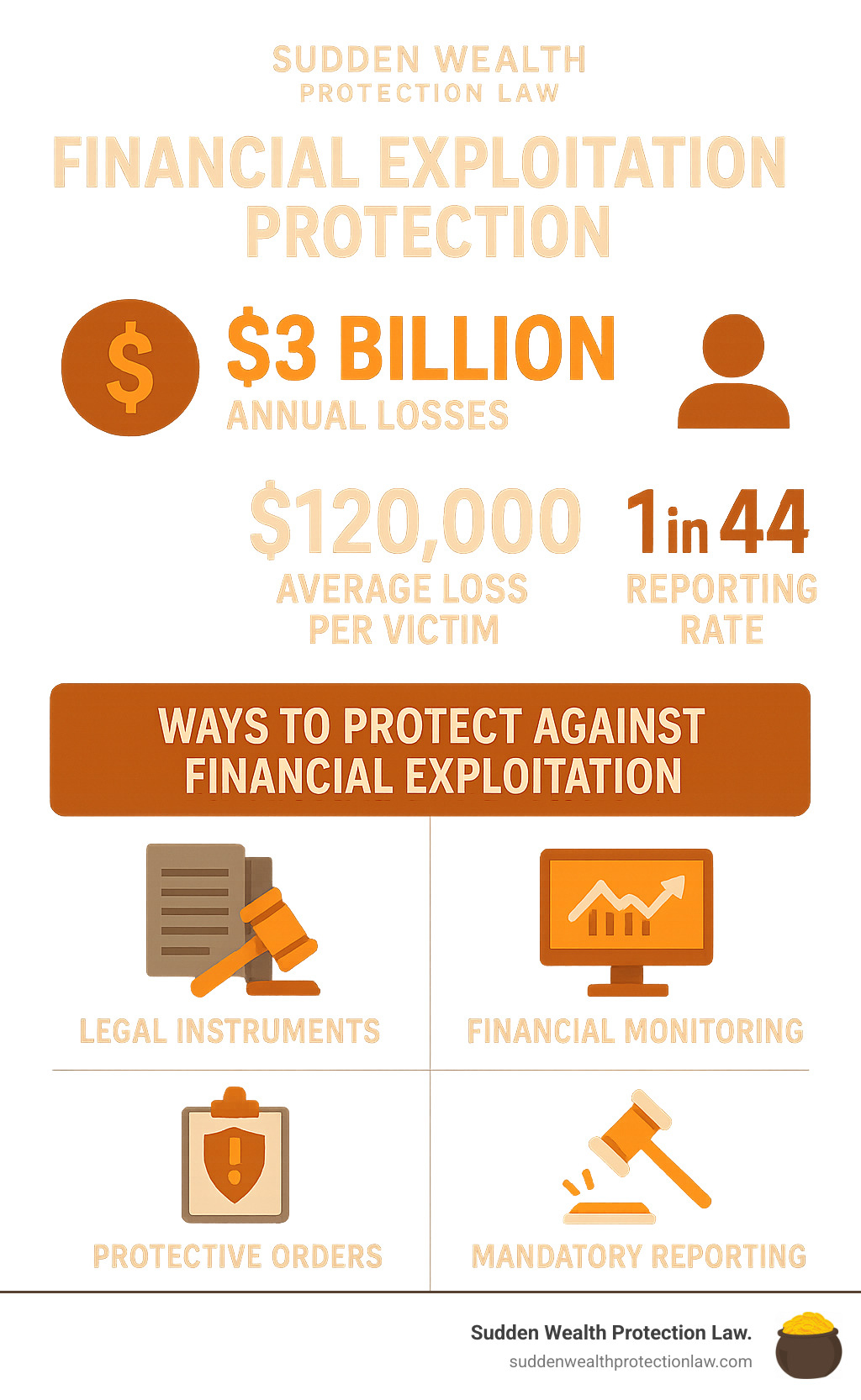
- Annual Cost: Over $3 billion in losses to older Americans
- Average Loss: $120,000 per victim
- Reporting Rate: Only 1 in 44 cases ever reported
- Who’s Protected: Adults 65+, those with disabilities, and other vulnerable individuals
- Key Protections:
- Legal tools (POAs, Asset Vault Trusts)
- Financial monitoring systems
- Temporary transaction holds
- Protective orders
- Mandatory reporting laws
Financial exploitation occurs through various means – from outright theft and scams to more subtle forms of undue influence where a person in a position of trust misuses that relationship. The victims are often isolated, cognitively impaired, or dependent on others for care, making them particularly vulnerable.
The statistics are alarming. Elder financial exploitation costs older Americans more than $3 billion annually, with the average victim losing $120,000 per incident. Even more concerning is that only 1 in 44 cases is ever reported to authorities, creating a silent epidemic that leaves many victims without recourse.
In Arizona, there are strong legal protections available through the Adult Protective Services Act, which provides remedies for financial exploitation of vulnerable adults. These include mechanisms to recover damages, attorney fees, and even punitive damages in some cases.
I’m Paul E. Deloughery, founder of Sudden Wealth Protection Law, and I’ve dedicated my practice to helping Arizona families implement Financial Exploitation Protection strategies after witnessing how devastating these situations can be for victims and their loved ones.
Understanding Financial Exploitation Protection: Definitions, Who’s at Risk, and Common Tactics
When we talk about Financial Exploitation Protection, we’re addressing a serious issue that affects thousands of vulnerable adults each year. In Arizona, financial exploitation is legally defined under A.R.S. §46-451 as the “illegal or improper use of an incapacitated or vulnerable adult or the adult’s resources for another’s profit or advantage.” This covers everything from outright theft to subtle manipulation that can drain a lifetime of savings.
A “vulnerable adult” under Arizona law isn’t just about age – it includes any person 18 or older who struggles to protect themselves from abuse or exploitation due to physical or mental impairments. While this often includes elderly individuals (typically those 60+), it also encompasses adults with disabilities who rely on others for daily assistance or financial management.
The tactics exploiters use are constantly evolving, but undue influence remains at the core – using a position of trust to manipulate someone vulnerable. The Department of Justice’s Elder Justice Initiative has documented countless cases where perpetrators use techniques like phishing scams (impersonating legitimate organizations), romance scams (building fake relationships for financial gain), caregiver theft, and investment fraud schemes.
These aren’t isolated incidents. The National Adult Protective Services Association confirms that financial exploitation was the most commonly investigated form of elder abuse in 2021, showing just how widespread this problem has become.
Key Legal Terms You Must Know
When protecting yourself or loved ones from financial exploitation, understanding a few key legal terms can make all the difference:
Exploitation versus fraud may seem similar, but they have important distinctions. Exploitation typically involves someone known to the victim – a relative, caregiver, or “friend” who breaches trust. Fraud, on the other hand, is often perpetrated by strangers through scams or identity theft schemes.
When someone has fiduciary duty, they’re legally obligated to act in another person’s best interests. Family members with power of attorney, trustees, guardians, and conservators all have this responsibility. When they put their own interests first, they’ve crossed a serious legal line.
Arizona law protects “eligible adults” under the Adult Protective Services Act. This includes both vulnerable adults (those unable to protect themselves) and incapacitated adults (those unable to make or communicate responsible decisions) – understanding these distinctions helps identify appropriate legal remedies.
Who Faces the Greatest Risk?
Not everyone faces the same risk of financial exploitation. Several factors significantly increase vulnerability:
Social isolation creates the perfect environment for exploitation to flourish. Adults with limited social connections lack the protective oversight that comes from regular interaction with others. According to NAPSA, socially isolated older adults face a 26% higher risk of experiencing financial exploitation.
Cognitive decline affects approximately 10-20% of adults 65 and older, making them less able to detect scams or manipulation. About 5.3 million Americans have Alzheimer’s disease, including 11% of those 65+ and roughly 33% of those 85+.
Recent widowhood creates a perfect storm of vulnerability. The emotional impact of losing a spouse, combined with potentially managing finances independently for the first time, creates high-risk situations that exploiters are quick to target.
High net-worth individuals often become targets simply because they have more assets. The Consumer Financial Protection Bureau notes that households headed by someone 50 or older hold 75% of U.S. consumer financial assets – approximately $16 trillion – making them attractive targets.
Dependency on others for physical care, transportation, or managing affairs creates numerous opportunities for exploitation. This dependency can make victims reluctant to report abuse for fear of losing necessary support.
Most Common Schemes & Real-World Examples
The schemes exploiters use range from sophisticated to surprisingly simple, but all can be devastating:
Fake Investment Schemes prey on seniors’ concerns about having enough retirement savings. In one Arizona case we handled at Sudden Wealth Protection Law, a client’s parent lost over $200,000 to a “friend” who promised high returns on a real estate investment that never materialized. Similarly, unethical financial advisors sometimes convince elderly clients to liquidate safe investments for complex, high-commission products unsuitable for their needs.
Grandparent Scams exploit family connections. An impersonator calls claiming to be a grandchild in trouble, requesting emergency wire transfers. The DOJ Elder Justice Initiative notes these scammers often research family details through social media to make their stories convincing – “Grandma, please don’t tell Mom and Dad about this accident” is a common red flag.
Sweetheart Scams target emotional vulnerability. A new romantic interest, often met online, builds trust before requesting money for “emergencies,” travel, or investment opportunities. Recently widowed individuals seeking companionship are particularly vulnerable to these heartbreaking schemes.
Power-of-Attorney Abuse happens when trust is misplaced. For instance, a son with power of attorney for his mother might begin writing checks to himself far beyond reasonable compensation for assistance provided. Under Arizona law, this constitutes a clear breach of fiduciary duty unless specifically authorized.
Annuity Mis-sales often target seniors with deceptive sales tactics. Insurance agents may push products that lock up assets with surrender periods of 10-15 years and high annual expenses, as documented by the New York Department of Financial Services. These products might generate substantial commissions for the agent while providing minimal benefit to the senior.
Understanding these schemes is the first step toward effective Financial Exploitation Protection. Being able to recognize warning signs early can mean the difference between safeguarding a lifetime of savings and experiencing devastating financial loss.
Scientific research on elder financial exploitation shows this problem continues to grow, but with proper education and legal protections, we can help vulnerable adults maintain their financial independence and security.
More info about undue influence
Red Flags: How to Spot Financial Exploitation Early

Recognizing the warning signs of Financial Exploitation Protection can mean the difference between safeguarding a loved one’s assets and finding devastation after it’s too late. Across Arizona and nationwide, Adult Protective Services agencies have identified several key red flags that shouldn’t be ignored.
When Mom’s bank account suddenly shows several large withdrawals that she can’t explain, that’s not just forgetfulness—it’s a warning sign. Similarly, if Dad’s prized coin collection mysteriously disappears, or if Grandma suddenly can’t pay her electric bill despite having adequate income, something concerning may be happening.
One particularly troubling sign is the appearance of a new “best friend” who takes an unusual interest in your loved one’s finances. As one client told me, “My father never let anyone touch his checkbook for 50 years—until this new ‘friend’ from church came along.”
Pay attention if your loved one seems fearful or anxious when certain individuals are present. This discomfort often speaks volumes about underlying dynamics. Another visible clue? Piles of unopened mail, especially bills or collection notices, when your family member was previously organized and responsible.
Undue influence deserves special attention in the field of Financial Exploitation Protection. This subtle form of manipulation occurs when someone uses their position of trust to override a vulnerable person’s free will. The perpetrator often isolates the victim, creating dependency while systematically taking control of their finances. Learn more about undue influence and how it works on our website.
Behavioral Warning Signs Family Should Watch
Family members often notice the first subtle shifts in behavior that signal potential exploitation.
When your normally social mother becomes withdrawn and stops attending family gatherings, this isolation could be deliberate—orchestrated by someone exerting control. I’ve seen cases where exploiters convince elderly victims that “your children only want your money,” creating artificial distance from protective family members.
Confusion about financial matters represents another red flag, especially when your loved one previously managed money competently. When Dad suddenly can’t explain recent transactions or seems bewildered by account statements, this cognitive disconnect warrants investigation.
Perhaps most telling is a new secretiveness about money. When your previously open parent suddenly changes the subject when finances come up or hides paperwork when you visit, someone may be coaching them to keep family in the dark about financial activities.
Account & Paperwork Clues Professionals Detect
Financial professionals are increasingly trained to spot technical warning signs that might escape family members’ notice.
Unusual ATM withdrawal patterns often trigger alerts at financial institutions. When a homebound senior suddenly has daily maximum withdrawals from various locations across town, banks rightfully become suspicious. One Arizona bank manager told me, “When we saw $500 daily withdrawals from an 87-year-old client who rarely left home, we knew something wasn’t right.”
Changed beneficiary designations represent another serious warning sign. When long-established estate plans are suddenly revised to benefit new acquaintances or recently-hired caregivers, this deserves scrutiny. This is particularly true when the changes disinherit family members who had previously been included.
Signature inconsistencies often reveal exploitation in progress. When Mom’s neat penmanship suddenly appears shaky or completely different on checks and legal documents, forgery may be occurring. Financial professionals are trained to compare signatures against historical samples and flag suspicious discrepancies.
In a case we handled last year, an alert bank employee noticed that a caregiver was making weekly maximum ATM withdrawals from an elderly client’s account—always on the same day and always for the exact same amount. This pattern triggered a protective response that ultimately prevented thousands in additional losses.
Recognizing these warning signs early allows for swift intervention through Financial Exploitation Protective Orders and other legal remedies that can halt exploitation before life savings disappear.
Financial Exploitation Protection Laws & Orders
Arizona takes the protection of vulnerable adults seriously, with some of the strongest safeguards in the nation. At the heart of these protections is A.R.S. §46-456, which creates civil liability for anyone in a position of trust who misuses a vulnerable adult’s assets. This powerful law has helped countless Arizona families recover assets and hold exploiters accountable.
On the federal front, the Senior Safe Act provides financial institutions with immunity when they make good-faith reports of suspected exploitation. This protection encourages banks and investment firms to speak up when they notice suspicious activity without fear of liability. Meanwhile, the Consumer Financial Protection Bureau (CFPB) has developed comprehensive guidance to help financial professionals identify and report concerning patterns.
Many states, including Arizona, have incorporated elements of the North American Securities Administrators Association (NASAA) model act, which establishes protocols for reporting, notification, and temporarily delaying suspicious transactions.
| Protection Measure | Arizona Law | Federal Framework |
|---|---|---|
| Civil Liability | A.R.S. §46-456 creates liability for misuse of vulnerable adult’s assets | No direct equivalent |
| Criminal Penalties | A.R.S. §13-3215 makes exploitation a class 2 or 3 felony | Various federal fraud statutes may apply |
| Mandatory Reporting | Required for certain professionals under A.R.S. §46-454 | Encouraged but not mandated federally |
| Transaction Holds | Permitted under Arizona’s adaptation of NASAA model | Senior Safe Act provides immunity for good-faith reporting |
| Statute of Limitations | Two years from “actual findy” under A.R.S. §46-455(K) | Varies by applicable federal statute |
| Damages Available | Actual damages plus up to double damages, attorney fees, and potential punitive damages | Depends on statute; typically actual damages plus potential penalties |
What Is a Financial Exploitation Protective Order?
When a loved one is actively being exploited, time is of the essence. A financial exploitation protective order provides immediate relief through the civil court system. Think of it as a financial restraining order that can be obtained quickly to stop the bleeding.
These protective orders pack a powerful punch – they can freeze accounts, block transactions, and create legal barriers between the vulnerable adult and the exploiter. Unlike some legal remedies, these orders don’t require any specific relationship between the victim and exploiter. Whether the perpetrator is a family member, caregiver, or complete stranger, the court can intervene.
One key advantage is that these orders work through the civil system rather than requiring criminal charges. This means they can be implemented with a lower burden of proof while law enforcement builds a potential criminal case. In Arizona, these orders work beautifully alongside other remedies available under the Adult Protective Services Act, creating a shield while more permanent solutions are arranged.
State & Federal Financial Exploitation Protection Framework
Financial Exploitation Protection works best as a coordinated effort between multiple agencies and reporting systems:
Adult Protective Services (APS) serves as the front-line response team, investigating reports and connecting victims with resources. When financial institutions spot suspicious activity, they file Suspicious Activity Reports (SARs) with the Financial Crimes Enforcement Network (FinCEN), creating a paper trail that can help build cases against exploiters.
Arizona’s mandatory reporting laws require certain professionals – including healthcare providers, social workers, and financial professionals – to report suspected exploitation. This creates a safety net where those who frequently interact with vulnerable adults become part of the protection framework.
The clock on legal action starts ticking when you discover the exploitation. In Arizona, victims have two years from “actual finding” of the exploitation to bring claims under the Adult Protective Services Act, as established in the important Norvelle case. This finding rule is crucial, as many victims don’t immediately realize they’ve been exploited.
While this multi-layered approach provides significant protection, gaps remain, particularly when exploitation goes undetected for extended periods or when victims are too embarrassed or fearful to report what’s happened.
Asset Vault Trust: Private Financial Exploitation Protection Strategy

At Sudden Wealth Protection Law, we’ve developed a private solution that provides robust Financial Exploitation Protection through our Asset Vault Trust (also known as a 541 Trust). This specialized irrevocable trust offers both strong asset protection and remarkable flexibility – a combination that’s hard to find in standard estate planning tools.
The Asset Vault Trust creates a legal fortress around your assets through its irrevocable structure. Once assets are placed in the trust, they’re protected from creditors and potential exploiters who might otherwise pressure a vulnerable adult into changing their estate plan or making harmful financial decisions.
What makes our approach unique is the incorporation of a special power of appointment that maintains flexibility while preserving protection. The trust can be customized with provisions that prevent exploitation while ensuring assets remain available for legitimate needs. Independent trustees provide an additional layer of oversight, making it extremely difficult for exploiters to manipulate the system.
Standard revocable living trusts offer convenience but minimal protection against exploitation. By contrast, an Asset Vault Trust creates legal barriers that are exceedingly difficult for exploiters to overcome. I’ve seen how these trusts have protected clients’ loved ones from both opportunistic strangers and, sadly, manipulative family members.
For more information about how an Asset Vault Trust can protect your family’s assets, visit our Asset Vault Trust page or learn more about our asset protection attorney services.
Preventive Strategies for Individuals, Caregivers, and Financial Institutions
Preventing financial exploitation isn’t just about reacting after the fact—it’s about building strong protective barriers before problems arise. Effective Financial Exploitation Protection works best when everyone plays their part in a coordinated approach.

I’ve seen how simple preventive measures can save families from heartache and financial devastation. Something as straightforward as a credit freeze can block potential exploiters from opening new accounts in a vulnerable person’s name. Designating trusted contacts gives financial institutions someone to reach out to when they notice suspicious activity—often catching problems before major losses occur.
Financial literacy matters too. Programs like MoneySmart training specifically designed for older adults help them recognize scams and manage their finances confidently. The real power comes when we work together—when financial institutions, adult protective services, and law enforcement coordinate their efforts.
The good news is that federal agencies recognize this need. The CFPB, FINRA, SEC, and other regulatory bodies have issued a comprehensive interagency statement on elder financial exploitation that helps financial professionals identify and respond to suspicious activity.
For Older Adults & Families
When I work with families on Financial Exploitation Protection plans, I often recommend a system of checks and balances that maintains independence while adding layers of protection.
Regular durable POA audits are crucial—don’t just sign a power of attorney and forget about it. Set up a system where your agent must provide regular accounting of their actions. And when it comes to joint accounts, less is more. Instead of adding someone to all your accounts, consider limited-purpose joint accounts for specific needs like bill paying.
Your estate plan isn’t a “set it and forget it” document either. Regular estate plan updates ensure your documents reflect your current wishes and include specific protections against exploitation. Many of my clients find peace of mind by separating financial roles—perhaps having one trusted person handle day-to-day bills while another reviews monthly statements for red flags.
At Sudden Wealth Protection Law, we design personalized protection plans that fit each family’s unique situation. Learn more about how we help protect your assets with strategies custom to your specific concerns.
For Caregivers & Service Providers
Caregivers stand on the front lines of Financial Exploitation Protection. Whether you’re a family member or professional caregiver, proper staff training helps you recognize warning signs before major exploitation occurs.
I always advise caregivers to establish clear systems for monitoring spending—watch for unusual purchases or services that never materialize. And don’t underestimate the importance of respite care. Caregiver burnout is real, and exhausted caregivers can make mistakes or, in worst-case scenarios, become tempted to cut corners ethically.
Professional caregivers should maintain detailed records of all financial transactions they handle. Be transparent and willing to participate in the oversight arrangements established by the family. This protects not just the vulnerable adult but you as well.
For service providers like nursing homes and assisted living facilities, clear policies regarding staff handling of resident finances create an important protective barrier. Visit our page on family wealth protection to learn more about comprehensive strategies that work.
For Banks & Investment Firms
Financial institutions have increasingly sophisticated tools to prevent exploitation, and they’re often the first line of defense against financial predators.
FINRA Rule 4512 requires firms to make reasonable efforts to obtain a “trusted contact” form for customer accounts—someone they can reach out to if they notice concerning activity. This simple step has prevented countless exploitation attempts. Similarly, FINRA Rule 2165 permits firms to place transaction holds when exploitation is suspected, creating a crucial cooling-off period while concerns are investigated.
SAR/FinCEN reporting provides another layer of protection, as financial institutions file Suspicious Activity Reports with the Financial Crimes Enforcement Network when they spot potential exploitation. And thanks to the Senior Safe Act immunity, financial professionals can report suspected exploitation in good faith without fear of liability.
At Sudden Wealth Protection Law, we work with clients and their financial institutions to establish appropriate protections while ensuring legitimate access to funds. For families dealing with suspected exploitation that has already occurred, we offer trust and estate dispute services to help recover assets and hold perpetrators accountable.
The most effective protection comes from a combination of legal safeguards, financial monitoring, and family vigilance—all working together to create a shield around vulnerable loved ones.
Taking Action: Reporting and Recovery Steps in Arizona
When you spot signs of financial exploitation, quick action can make all the difference. Arizona offers several clear pathways to report suspected abuse and begin the recovery process.
Arizona Adult Protective Services (APS) should be your first call at 1-877-SOS-ADULT (1-877-767-2385). This dedicated hotline connects you directly with specialists trained to investigate exploitation cases. For those who prefer online reporting, the Department of Economic Security (DES) provides a secure portal to submit detailed reports.
Don’t overlook your local police department – financial exploitation is a crime, and law enforcement plays a crucial role in building cases against perpetrators. For scams that originated online, the Internet Crime Complaint Center (IC3.gov) offers specialized reporting tools.
Remember – the sooner you report, the better chance of freezing assets and recovering funds. Many of our clients have seen significantly better outcomes when they acted quickly rather than waiting to see if the situation would resolve itself.
How to Report Suspected Exploitation in Arizona
Arizona’s reporting system distinguishes between two types of reporters. Mandatory reporters include healthcare providers, social workers, and certain financial professionals who are legally required under A.R.S. §46-454 to report suspected exploitation. Everyone else falls into the voluntary reporter category – and yes, that includes concerned family members who often spot problems first.
When making your report to APS, be ready with specific details: the vulnerable adult’s name and contact information, details about suspicious transactions, and information about the suspected perpetrator. The intake specialist will also ask about immediate safety concerns.
Documentation is powerful. Gather relevant financial records before calling – account statements showing unusual withdrawals, copies of suspicious checks, or recently changed legal documents. These records provide investigators with concrete evidence to build their case.
I’ve seen how thorough initial reporting dramatically improves outcomes. In one case, a client’s detailed documentation of her father’s bank statements helped APS freeze accounts within 48 hours of reporting, preventing an additional $50,000 withdrawal the exploiter had planned.
Legal Remedies & Potential Penalties for Perpetrators
Arizona doesn’t take financial exploitation lightly. Under A.R.S. §13-3215, perpetrators face serious consequences – financial exploitation of a vulnerable adult is classified as either a class 2 or class 3 felony, depending on the circumstances and amount taken.
The courts have multiple tools to hold exploiters accountable:
Restitution orders require perpetrators to repay stolen funds, while Arizona’s Adult Protective Services Act allows for treble damages – up to three times the actual losses. During investigations, courts can issue asset freeze orders to prevent perpetrators from spending or hiding ill-gotten gains.
These penalties have real teeth. Just last year, an Arizona court sentenced a perpetrator to five years in prison after they exploited an elderly neighbor through power of attorney abuse. The court also ordered over $300,000 in restitution – demonstrating Arizona’s commitment to justice for exploitation victims.
Rebuilding Financial Stability After Exploitation
Recovery extends beyond the courtroom. The emotional and financial healing process takes time, but specific steps can help restore stability and peace of mind.
Start with regular credit report monitoring to catch any lingering unauthorized accounts or identity theft issues. The Consumer Financial Protection Bureau offers excellent “Managing Someone Else’s Money” guides – free resources that help family members who step in to manage finances after exploitation.
Local Area Agencies on Aging provide counseling services and connection to community resources specifically designed for exploitation survivors. Many clients find these support services invaluable during the recovery process.
For long-term protection, consider implementing stronger legal safeguards. At Sudden Wealth Protection Law, we often recommend an Asset Vault Trust as part of a comprehensive recovery plan. This specialized irrevocable trust creates a powerful barrier against future exploitation attempts while maintaining appropriate access to funds.
The path to recovery may seem overwhelming, but you don’t have to steer it alone. We help Arizona families not only recover from exploitation but also establish robust protections for the future. Learn more about our approach to addressing Financial Exploitation of Vulnerable Adults.
Conclusion & Next Steps
The devastating impact of elder financial abuse extends far beyond just financial losses. When vulnerable adults are exploited, they often suffer emotional trauma and may lose the independence they’ve cherished their entire lives. That’s why effective Financial Exploitation Protection isn’t just about safeguarding assets—it’s about preserving dignity and peace of mind.
I’ve seen how proper planning can make all the difference. At Sudden Wealth Protection Law, we’ve developed specialized Arizona solutions that address the unique challenges faced by vulnerable adults and their families. Our approach combines legal expertise with genuine compassion for what you’re going through.
The Asset Vault Trust (also known as a 541 Trust) stands as our flagship protection strategy. Unlike standard estate planning tools, this specialized trust creates a powerful barrier against potential exploiters while maintaining the flexibility families need for everyday financial management. It’s protection without unnecessary restriction.
Every family’s situation is different. The relationship dynamics, financial circumstances, and specific vulnerabilities vary widely from one client to the next. That’s why we don’t believe in one-size-fits-all solutions. Instead, we take the time to understand your unique concerns and develop customized protection strategies that address your specific needs.
If you’re noticing some of the warning signs we’ve discussed—unusual withdrawals, new “friends” with excessive interest in finances, or changes in your loved one’s behavior around money matters—act quickly. Don’t wait to take action until it’s too late to put financial exploitation protection in place. These situations rarely resolve themselves, and early intervention is critical.
I invite you to schedule a consultation with our team at Sudden Wealth Protection Law. Together, we can assess your situation, identify vulnerabilities, and develop a comprehensive protection plan custom to your family’s needs. Sometimes, a simple conversation can be the first step toward preventing a devastating loss.
Prevention is infinitely preferable to recovery. The emotional and financial costs of exploitation can be enormous, but many cases are preventable with proper planning and protection. The steps you take today could save your family significant heartache tomorrow.
For more detailed information about our approach to protecting vulnerable adults, please visit our resource page on Financial Exploitation of Vulnerable Adults. We’re here to help you steer these complex waters with confidence and clarity.

