

An irrevocable trust for Medicaid planning is a specialized legal arrangement that protects your assets while helping you qualify for Medicaid long-term care benefits. This powerful estate planning tool allows you to preserve wealth for your loved ones while still accessing necessary healthcare services as you age.
Quick Answer: Irrevocable Trust for Medicaid Planning
| What It Is | How It Works | Key Benefits |
|---|---|---|
| A legal arrangement where you permanently transfer assets to a trust | Assets in the trust aren’t counted toward Medicaid’s $2,000 asset limit after the 5-year look-back period | • Protects assets from nursing home costs • Preserves inheritance for heirs • Shields assets from estate recovery |
The reality of long-term care costs is sobering. In 2024, the average monthly cost for a private nursing home room in the U.S. is nearly $10,000. Most Americans haven’t saved enough to cover years of such expenses without depleting their life savings.
While Medicare covers acute medical care, it provides very limited coverage for long-term nursing care. This is where Medicaid steps in – but only after you’ve spent down nearly all your assets to meet strict eligibility requirements.
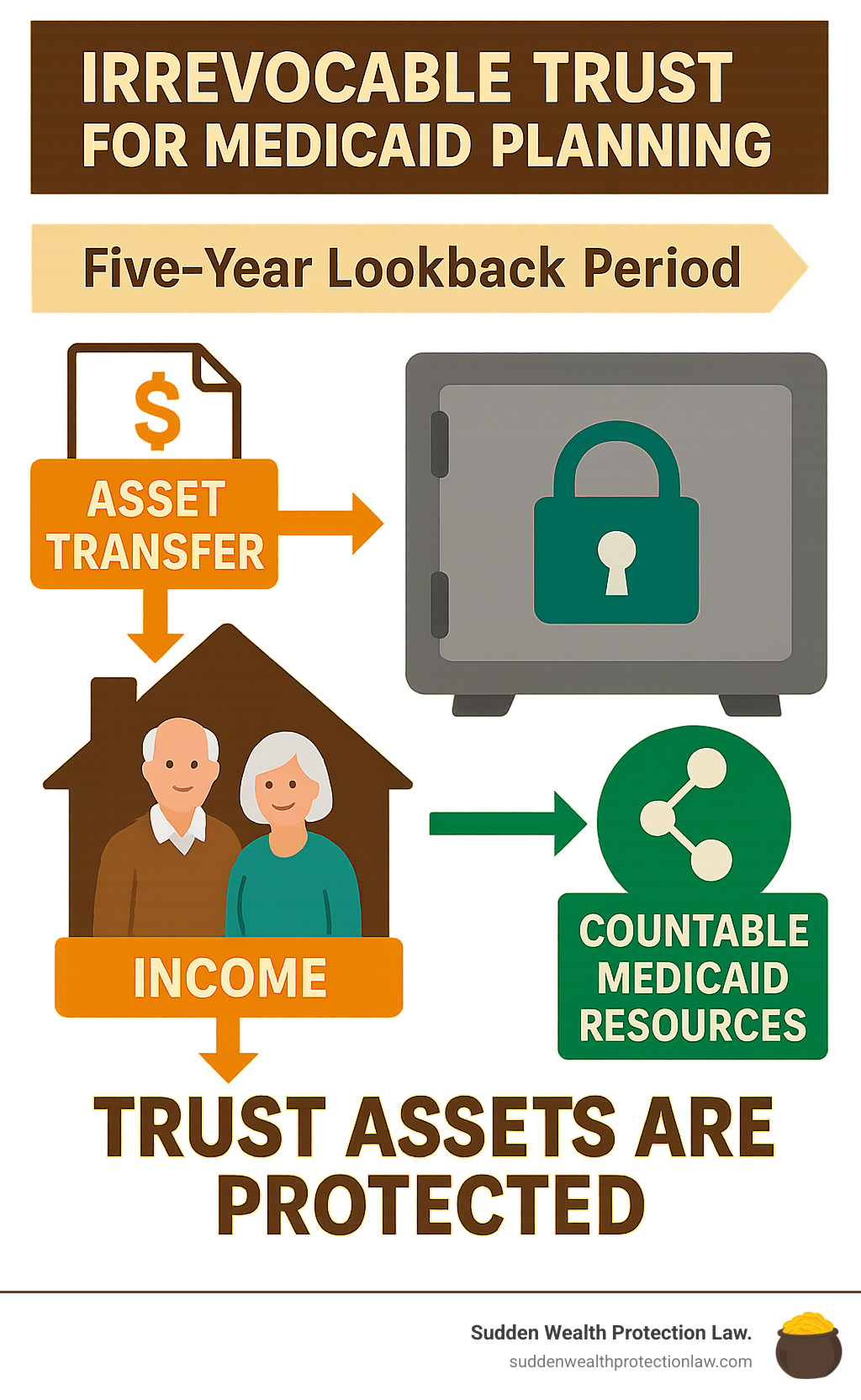
An irrevocable trust creates a legal barrier between you and your assets. Once assets are transferred to the trust:
- They’re no longer considered “yours” for Medicaid eligibility
- They’re protected from nursing home and creditor claims
- They can pass to your beneficiaries intact
The catch? You must plan ahead. Most states impose a 5-year “look-back period” on asset transfers, meaning anything moved into trust within 5 years of applying for Medicaid can trigger a penalty period of ineligibility.
My name is Paul E. Deloughery, founder of Sudden Wealth Protection Law in Phoenix, with over 25 years of experience helping Arizona families steer the complexities of irrevocable trust for Medicaid planning and asset protection strategies. My approach combines legal expertise with practical solutions that preserve your hard-earned assets while ensuring you receive the care you need.
Basic irrevocable trust for medicaid planning vocab:
– advantages of irrevocable trust
– benefits irrevocable funeral trust
Understanding Irrevocable Trusts for Medicaid Planning
Picture this: you’ve worked hard your entire life, built a nest egg, and now you want to make sure it’s protected as you age. That’s where an irrevocable trust for Medicaid planning comes in – a powerful tool in your estate planning toolkit that can make all the difference.
These specialized trusts (sometimes called Medicaid Asset Protection Trusts or MAPTs) work by permanently transferring ownership of your assets from you (the grantor) to someone you trust (the trustee). This trustee then manages these assets for the benefit of your chosen loved ones. The magic happens when, under Arizona law, these assets are no longer counted toward your Medicaid eligibility after the five-year look-back period expires.
Why does this matter? Because Medicaid has strict asset limits – typically just $2,000 for a single applicant in Arizona. Without proper planning, many Arizona families find themselves forced to spend nearly everything they’ve saved before qualifying for the care they need.
“When I first explain this to clients, I often see a look of relief wash over their faces,” says Paul Deloughery. “They suddenly realize there’s a legitimate way to protect what they’ve worked so hard to build.”
Beyond Medicaid qualification, these trusts offer robust creditor protection. Since you no longer legally own the assets, they’re generally shielded from nursing home claims, medical creditors, and other potential threats to your estate.
Here in Arizona, our asset protection laws provide excellent foundations for this type of planning. However, success depends on working with an attorney who understands both federal Medicaid regulations and Arizona-specific requirements for ALTCS (Arizona Long Term Care System), our state’s Medicaid program for long-term care.
More info about Estate Planning
What Is an Irrevocable Trust and How Does It Work?
An irrevocable trust begins with a formal trust deed – a legal document that creates the trust, names the trustee(s) and beneficiaries, and outlines how assets will be managed and distributed. The defining characteristic that makes it “irrevocable” is just what it sounds like – once established, you generally cannot change its terms or revoke it without the consent of the beneficiaries.
This loss of control might sound intimidating at first, but it’s actually the key feature that makes the trust effective for Medicaid planning. Since you’ve permanently given up ownership of the assets, they’re no longer considered yours for Medicaid eligibility purposes (after the look-back period).
The good news? A well-drafted irrevocable trust for Medicaid planning can still provide you with important rights, such as:
- The right to receive income generated by trust assets
- The right to continue living in your home if it’s transferred to the trust
- The ability to change beneficiaries through a limited power of appointment
As Martha, a client in her 70s, told me after we established her trust: “I was worried about giving up control, but now I sleep better knowing my children will inherit something even if I need nursing home care. That peace of mind is worth everything.”
Benefits of an Irrevocable Trust for Medicaid Planning
The beauty of an irrevocable trust for Medicaid planning lies in its multiple layers of protection. After the five-year look-back period, assets in the trust aren’t counted toward Medicaid’s strict asset limits, helping you qualify for benefits while preserving your family’s wealth.
Just as important, these trusts provide an estate recovery shield. In Arizona, after a Medicaid recipient passes away, ALTCS can place liens on their estate to recover costs paid for their care. Assets properly held in an irrevocable trust generally avoid this recovery process entirely.
The wealth transfer aspect is equally valuable – your trust ensures your assets pass to your chosen beneficiaries rather than being depleted by skyrocketing long-term care costs. Many clients are surprised to learn about the tax advantages too. A properly structured irrevocable trust can maintain certain tax benefits, such as the stepped-up basis for inherited property and the capital gains tax exclusion for a primary residence.
As a real-world example, we recently helped Robert and Susan, an Arizona couple in their early 70s, transfer their $450,000 home and $300,000 in investments into an irrevocable trust. Five years later, when Robert needed nursing home care, these assets remained protected while he qualified for ALTCS benefits – potentially saving hundreds of thousands of dollars for their children’s inheritance.
When to Set Up an Irrevocable Trust for Medicaid Planning
Timing is perhaps the most critical factor when using an irrevocable trust for Medicaid planning. Due to the five-year look-back period, the ideal time to establish and fund your trust is at least five years before you anticipate needing Medicaid benefits.
We generally recommend clients consider this planning:
- During their healthy retirement years (typically ages 65-75)
- When they have assets to protect beyond what they need for living expenses
- Before any diagnosis that might indicate future long-term care needs
In Arizona, the ALTCS application process can be particularly complex, with waiting periods for eligibility determinations. Planning well in advance gives you the greatest protection and flexibility.
“The best time to plant a tree was 20 years ago. The second-best time is now,” goes the old saying. The same applies to Medicaid planning. Even if you’re already facing health challenges, options still exist. For those with imminent care needs, other strategies may be more appropriate, as we’ll discuss later. Even “crisis planning” options exist – it’s rarely too late to protect at least some assets.
Revocable vs. Irrevocable: Impact on Medicaid Eligibility
When it comes to protecting your assets while qualifying for Medicaid, the type of trust you choose makes all the difference. Let me explain the crucial distinctions that could save your family’s legacy.
A revocable trust gives you comfort and control—you can change beneficiaries, pull assets out, or even dissolve it entirely whenever you wish. But here’s the catch: Medicaid sees right through this arrangement. Since you maintain control, every penny in a revocable trust counts against your $2,000 asset limit for eligibility.
An irrevocable trust for Medicaid planning, on the other hand, requires you to release the reins. Yes, this loss of control feels uncomfortable for many of my clients initially. But it’s precisely this separation that makes the trust powerful for Medicaid planning. After the five-year look-back period, those assets become invisible to Medicaid’s asset counters.
As Martha, a retired schoolteacher from Scottsdale, told me: “I was terrified to give up control of my savings, but Paul explained how my irrevocable trust was like putting my assets in a lockbox with a five-year timer. Once that timer expired, my nest egg was safe from nursing home costs while I could still enjoy the income.”
| Feature | Revocable Trust | Irrevocable Trust for Medicaid |
|---|---|---|
| Control | Full control to change or revoke | Limited or no control once established |
| Medicaid Treatment | Assets fully countable | Assets not countable after 5-year look-back |
| Creditor Protection | No protection | Strong protection |
| Tax Treatment | No separate tax entity | Can be structured as grantor trust |
| Income Rights | Full access to income and principal | Can retain income rights only |
| Home Protection | No protection from Medicaid | Can protect home after look-back period |
| Estate Recovery | Subject to recovery | Protected from recovery |
More info about Revocable Trust vs Irrevocable Trust
The Medicaid Look-Back Rule Explained
The five-year look-back rule is the cornerstone of Medicaid planning. Think of it as Medicaid’s financial time machine—they’ll examine every financial move you’ve made during the 60 months before you apply.
Any assets transferred for less than fair market value—including transfers to an irrevocable trust for Medicaid planning—within this window can trigger a penalty period when you’ll be ineligible for benefits, even if you’re otherwise qualified.
Arizona calculates this penalty period using a simple formula: the value of your transferred assets divided by the “penalty divisor” (the average monthly cost of nursing home care in Arizona). This divisor gets updated periodically to reflect current costs.
Let me share a real example: One of my Gilbert clients transferred $255,000 to an irrevocable trust just two years before needing nursing home care. With Arizona’s penalty divisor at $8,500, this created a 30-month penalty period ($255,000 ÷ $8,500 = 30). This meant 30 months of private-pay nursing care before Medicaid would kick in—a costly mistake that proper timing would have avoided.
This is why planning ahead is so crucial. Transfers made more than five years before applying don’t trigger these painful penalties.
Understand Medicaid’s Look-Back Period
Income-Only vs. Full Asset Transfer Strategies
When setting up your irrevocable trust for Medicaid planning, you have important choices about what rights to keep:
With an income-only strategy, you transfer assets to the trust but keep receiving all income those assets generate. The principal stays protected in the trust, eventually passing to your beneficiaries. This works particularly well in Arizona because our ALTCS program (Arizona’s Medicaid) has an income cap, but allows you to direct excess income into a Qualified Income Trust (also called a Miller Trust) to maintain eligibility.
The full asset transfer strategy offers maximum protection by transferring assets without keeping any income rights. While this approach bulletproofs your assets, it means you can’t directly benefit from them.
Most of my Arizona clients prefer a balanced approach. Take the Johnsons from Mesa—we helped them transfer their rental property to an irrevocable trust while keeping income rights, but fully transferred their stock portfolio. This gave them ongoing rental income for daily expenses while protecting their investments for their children.
Your ideal strategy depends on your income needs, other resources, and family goals. The beautiful thing about working with a dedicated Arizona asset protection attorney is crafting a solution that fits your unique situation rather than forcing you into a one-size-fits-all approach.
Medicaid Asset Protection Trusts (MAPTs): Mechanics and Timing
A Medicaid Asset Protection Trust (MAPT) is one of the most reliable ways to create an irrevocable trust for Medicaid planning—especially here in Arizona. The idea is simple: you move certain assets out of your name and into a trust, where they’re managed by someone else (the trustee), all with the goal of qualifying for Medicaid (ALTCS in Arizona) after the five-year look-back period.
Let’s walk through the nuts and bolts. First, these trusts are truly irrevocable. Once you set it up, you can’t just change your mind and take your assets back—or change the rules—without the beneficiaries’ okay. That’s tough for some folks, but it’s exactly why these trusts work for Medicaid planning.
Second, you can’t be your own trustee. Usually, people pick a trusted family member—often an adult child—but sometimes a professional trustee makes sense, especially if family drama is a concern or you want extra peace of mind.
Third, you can keep the right to receive income from the trust, but you cannot get to the principal. That means any investment earnings or rental income can come to you, but the assets themselves are locked away, safe from Medicaid’s spend-down rules.
Your MAPT will also name beneficiaries—typically your children or other loved ones—who’ll get the trust assets after you pass. And many MAPTs include a limited power of appointment, which is legal-speak for “you can change who gets what when you’re gone, but you still can’t grab the assets for yourself.” It’s a helpful bit of flexibility, especially if your family circumstances change.

Timing is everything when it comes to MAPTs. Here in Arizona, you want to get your trust established and funded at least five years before you think you’ll need Medicaid. This way, by the time you apply, all trust assets are fully protected from the ALTCS spend-down and estate recovery rules.
Picking your trustee is important. Choose someone responsible, organized, and likely to outlive you. Many people select a child, but if family relationships are complicated or you prefer a neutral third party, a professional trustee is a solid option.
For married couples, there are special strategies. Sometimes it makes sense for each spouse to have a separate MAPT, or one spouse can keep more assets as the “community spouse” under Arizona rules. Good planning here can make a huge difference in what’s protected.
Assets You Can—and Cannot—Place in a Medicaid Irrevocable Trust
Here’s where careful planning matters: not everything belongs in a MAPT. In Arizona, the most common assets to put in your irrevocable trust for Medicaid planning are your primary residence, additional real estate (like a second home or rental property), non-retirement brokerage accounts, extra bank funds, life insurance with cash value, business interests, and sometimes valuable collectibles.
But be careful—some assets should not go into the trust. Retirement accounts (like IRAs or 401(k)s) are a big no-no, because moving them would trigger immediate income tax. Vehicles are usually best left out, since Arizona ALTCS ignores one car per household anyway. And keep your everyday checking account and personal items (like furniture or clothes) outside the trust—you’ll need access to those for daily living. Finally, don’t transfer assets into the trust that you might need to spend within the next five years.
Arizona gives special protection to your primary home. While it’s typically exempt while you’re alive, it can be snatched up by estate recovery after you pass away if it’s not in a trust. By putting your home in your MAPT, you secure it for your family’s future, once the five-year look-back is up.
A recent client in Phoenix did just that—he placed his house, a rental condo, and a healthy investment account into a MAPT, but kept his car and enough cash outside the trust for daily expenses. This balanced approach let him protect a big chunk of his wealth for his kids, without sacrificing his comfort.
Tax Implications of Funding a MAPT
A big concern people have is taxes. The good news: a well-drafted irrevocable trust for Medicaid planning can be set up as a “grantor trust” under IRS rules. That means you keep using your Social Security number, trust income is reported on your personal tax return, and there’s no separate trust tax return to file. You also keep the capital gains tax exclusion if you sell your main home—and after your death, your heirs can get a “step-up” in basis, which can save them a bundle if they sell inherited property.
There’s usually no immediate income tax hit when you transfer assets, but you may need to file a gift tax return (Form 709) just for recordkeeping—don’t worry, most folks owe no actual gift tax because of the large lifetime exemption.
Clients are often surprised (and relieved!) to hear that putting assets in a trust often helps their kids come out ahead tax-wise, not behind.
Irrevocable Trust for Medicaid Planning and Arizona’s Asset Vault Trust
At Sudden Wealth Protection Law, we believe in going beyond the basics. That’s why we offer the Asset Vault Trust, our Arizona-specific solution for families who want both protection and flexibility. Our Asset Vault Trust is our name for what’s sometimes called a 541 Trust. It’s an irrevocable trust for Medicaid planning with a twist: it includes a special power of appointment. That means while you can’t benefit from the trust assets yourself, you can adjust who inherits, without risking the asset protection you need.
Key features of our Asset Vault Trust:
- Strong protection from Medicaid spend-down and estate recovery, once the five-year look-back has passed
- Greater flexibility to update beneficiaries as family needs change, using the special power of appointment
- Creditor protection from lawsuits or other claims against you
- Preserved tax advantages like the step-up in basis for your heirs
- Control over changing future circumstances—without losing Medicaid eligibility
For example, a client in Scottsdale used an Asset Vault Trust to protect his investment portfolio and home, while keeping the option to change beneficiaries if family relationships evolved. He gained peace of mind—and his family gained security.
The Asset Vault Trust is Arizona’s next-generation tool for Medicaid asset protection. It’s the answer for families who want to protect what they’ve built, stay flexible, and sleep better at night.
More info about Asset Vault Trusts
Funding & Managing the Trust: Practical Steps
Turning your irrevocable trust for Medicaid planning from a paper document into a functioning legal shield requires proper funding—the process of actually transferring your assets into the trust. Think of it as moving your valuables from an open uped drawer into a secure vault.
For real estate, we’ll create a new deed transferring your property from your name to the trustee of your trust. I’ve guided hundreds of Arizona families through this process, making sure we preserve any property tax benefits you currently enjoy. One client in Scottsdale told me, “Watching you record that deed at the county office felt like the moment my home was truly protected.”

Financial accounts require working with your banks and brokerages to retitle them in the trust’s name. We’ll provide you with a certificate of trust—a condensed version of the trust document that financial institutions accept without seeing your entire private trust. Investment accounts, stocks, and bonds follow a similar process, though sometimes requiring coordination with multiple institutions.
For life insurance policies with cash value, we’ll help you change ownership to the trust while keeping your beneficiary designations aligned with your wishes.
Once your trust is funded, ongoing management becomes crucial. Your trustee needs to maintain clean financial boundaries, keeping trust assets separate from personal funds. Good record-keeping is essential—documenting income, expenses, and any distributions. As one retired teacher client put it, “It’s basically just good bookkeeping, which my daughter-trustee was already doing for her own finances.”
In Arizona, trustees have specific legal responsibilities to beneficiaries, including appropriate investment decisions and regular communication. We provide our clients with trustee guidelines that make these duties clear and manageable.
The most common mistake I see is incomplete funding—leaving assets out of the trust that should be protected. We’ll provide you with a comprehensive funding checklist and walk you through each step, ensuring nothing falls through the cracks.
Choosing the Right Trustee and Beneficiaries
Selecting your trustee is a bit like choosing a financial guardian for your future self. This person will manage trust assets according to your wishes, potentially for many years to come.
The ideal trustee is someone who is both trustworthy and financially responsible. They need good judgment and enough time to handle administrative duties. Most importantly, they must respect the purpose of your irrevocable trust for Medicaid planning and resist any pressure to bend the rules.
Family dynamics deserve careful consideration. I remember one client who initially named her oldest son as trustee because “he’s the firstborn.” After our discussion about his financial history and strained relationship with his siblings, she instead chose her daughter, who had accounting experience and better relationships with the family.
When multiple children are involved, consider whether naming one as trustee might create tension. Sometimes a neutral professional trustee—like a trust company or bank trust department—is worth the extra cost to preserve family harmony.
Always name at least one successor trustee as backup. Life is unpredictable, and your primary trustee might become unable or unwilling to serve when the time comes.
For beneficiaries, think beyond simply “who gets what” to consider each person’s unique circumstances. A beneficiary with special needs, addiction issues, or financial immaturity might need additional protections within the trust terms.
One client wisely noted: “I know my son would blow through an inheritance in months, while my daughter would carefully manage it for years. The trust lets me protect them both in different ways.”
How Trust Income Affects Medicaid Eligibility
Even when your irrevocable trust for Medicaid planning perfectly shields the principal (the assets themselves), the income those assets generate requires careful handling to maintain your Medicaid eligibility.
In Arizona, our ALTCS program (Arizona’s version of Medicaid for long-term care) caps monthly income at $2,829 for an individual applicant in 2024. This creates an interesting planning challenge: how to balance asset protection with income needs.
If your trust is designed to pay you income (like rental income from properties or interest from investments), that income counts toward your Medicaid cap. Social Security, pensions, and other income sources also count toward this limit.
For many of my clients, their total income exceeds this cap. That’s where a Qualified Income Trust (QIT)—also called a Miller Trust—becomes essential. This special trust serves as a pass-through account for excess income, directing it toward your care costs while maintaining your Medicaid eligibility.
I recently helped a retired Phoenix couple whose combined monthly income from Social Security, a small pension, and trust-generated rental income totaled about $3,400. By establishing a Miller Trust, they directed the excess above the cap to help cover their care costs while preserving their eligibility.
Some clients prefer structuring their irrevocable trust without income rights, meaning the trust income accumulates for their beneficiaries rather than being paid to them. This approach eliminates income concerns for Medicaid eligibility but means you can’t benefit from that income during your lifetime.
The right approach depends on your total income picture and your needs. As one client put it, “I needed that rental income to maintain my quality of life, so the Miller Trust solution was perfect—I keep my benefits while still enjoying the fruits of my lifetime of investments.”
Pros, Cons & Alternatives to Using an Irrevocable Trust
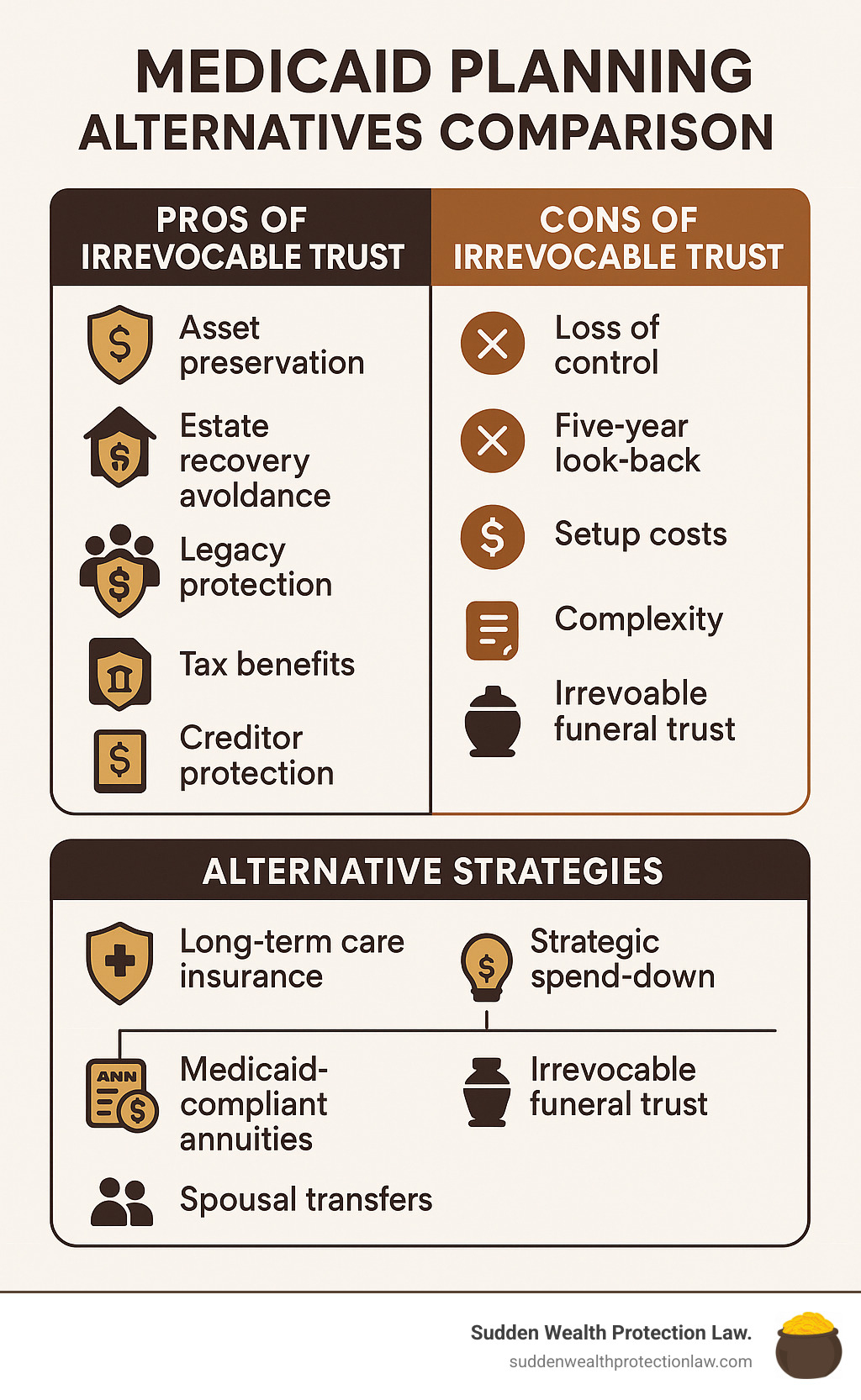
When considering an irrevocable trust for Medicaid planning, it’s important to weigh both the benefits and drawbacks. While these trusts offer powerful protection, they’re not a one-size-fits-all solution for every family’s situation.
The advantages of using an irrevocable trust for Medicaid planning are substantial. You’ll preserve assets that might otherwise be consumed by nursing home costs, which can quickly deplete a lifetime of savings. Your hard-earned wealth stays protected from Medicaid’s estate recovery efforts after death, ensuring your legacy passes to your loved ones as you intended. You’ll maintain important tax benefits like the step-up in basis, potentially saving your heirs thousands in capital gains taxes. Plus, these trusts offer broader protection against other potential creditors beyond just healthcare costs.
As one of my clients recently shared, “I worked too hard building my nest egg to see it vanish in a matter of months paying for nursing care. This trust gives me peace of mind that my children will inherit something meaningful.”
However, these benefits come with tradeoffs. You must relinquish direct control of assets placed in the trust—a psychological hurdle for many. The five-year look-back period means you need to plan well in advance; there’s no last-minute protection. Professional fees to establish a proper trust typically range from $2,000-$12,000, reflecting the complexity involved. And trust income may still affect your Medicaid eligibility, requiring additional planning.
Before committing to an irrevocable trust, consider these alternatives:
Long-term care insurance might be worth exploring if you’re still relatively young and healthy. While premiums can be substantial, this insurance provides coverage without requiring you to transfer assets.
Strategic spend-down allows you to convert countable assets into exempt forms. This might include making home improvements, paying off your mortgage, purchasing a new vehicle, arranging prepaid funeral services, or eliminating debt. Each of these uses preserves value for you while reducing countable assets.
Medicaid-compliant annuities convert a lump sum of money into an income stream. When properly structured, these specialized financial products can help you qualify for Medicaid while still benefiting from your assets.
An irrevocable funeral trust allows you to set aside funds specifically for funeral expenses (up to state limits) that won’t count toward Medicaid’s asset limits. This ensures your funeral wishes are funded while protecting some assets.
For married couples, spousal transfers can be particularly effective, as the community spouse can retain substantially more assets without affecting the ill spouse’s eligibility.
“We considered long-term care insurance,” one Phoenix couple told me, “but at our age, the premiums were prohibitive. The irrevocable trust made more sense for us, even with the five-year waiting period.”
In my practice, I often find that combining multiple strategies creates the most effective protection plan. For instance, an irrevocable trust for your home and investments paired with a Medicaid-compliant annuity for more liquid assets can provide both long-term protection and flexibility.
Your optimal approach depends on your specific circumstances—your age, health status, asset level, income needs, and family dynamics all play important roles in determining the right strategy.
Benefits of an Irrevocable Funeral Trust
Arizona-Specific Considerations and Common Pitfalls
When implementing an irrevocable trust for Medicaid planning in Arizona, you need to steer several state-specific factors to ensure your plan works effectively.
Arizona’s Medicaid program for long-term care, known as the Arizona Long Term Care System (ALTCS), has unique eligibility rules that differ from other states. These Arizona-specific regulations affect everything from income caps to resource limits, and understanding these nuances is essential for effective planning.
As a community property state, Arizona has distinct laws governing how assets can be transferred between spouses and potentially to trusts. This can create complications when funding an irrevocable trust, particularly if you’re married. In some cases, we need to properly document separate property to ensure clean transfers to your trust.
Our state’s homestead protection laws interact with trust planning in specific ways. While transferring your home to an irrevocable trust for Medicaid planning can protect it from estate recovery, it’s important to maintain certain rights to preserve homestead protections while you’re living there.
The Arizona Trust Code governs how trusts are administered, modified, and terminated in our state. Your trust must comply with these provisions to be effective, which is why cookie-cutter documents from online services or out-of-state attorneys often fail to provide the protection Arizona residents need.
I’ve seen families make several common mistakes when attempting Medicaid planning with trusts:
Naming yourself as trustee is perhaps the most frequent error. When you serve as trustee of your own irrevocable trust, ALTCS will likely determine you still have control over the assets, defeating the entire purpose of the trust.
Retaining too much control through provisions that give you excessive access to trust assets can invalidate the trust for Medicaid purposes. The trust must truly be irrevocable and limit your rights to the principal.
Improper funding is another pitfall. Either failing to properly transfer assets to the trust or transferring inappropriate assets (like IRAs) can create serious tax problems or undermine your planning entirely.
Many clients overlook income cap issues, not accounting for how trust income will affect their Medicaid eligibility. This can create unexpected problems when applying for benefits.
Perhaps most costly is premature application—applying for Medicaid before the five-year look-back period has expired on trust transfers. This can result in significant penalty periods of ineligibility.
One Phoenix client learned this lesson the hard way when he applied for ALTCS just four years after funding his trust. “I thought close enough would be good enough,” he told me. “That miscalculation cost our family over $60,000 in out-of-pocket care expenses that could have been avoided with proper timing.”
Working with an attorney who specializes in Arizona Medicaid planning can help you steer these state-specific considerations and avoid these common pitfalls, ensuring your trust accomplishes exactly what you intend.
Frequently Asked Questions About Irrevocable Trusts for Medicaid Planning
How soon before applying for Medicaid should I fund the trust?
The golden rule is: fund your irrevocable trust for Medicaid planning at least five years before you think you’ll need to apply for Medicaid (ALTCS here in Arizona). Why five years? Arizona, like most states, has a strict 60-month “look-back” period. Any assets you move into the trust during those five years are still counted for Medicaid eligibility and could cause a penalty period where you won’t qualify.
So, if you want the trust to shield your home and savings, it’s wise to get started early—think of it like planting a tree: the best time was five years ago, the second best time is today! Most folks set up their trusts during their healthy, active retirement years. This gives you peace of mind and keeps your planning options open.
Of course, life doesn’t always go according to schedule. If you fund the trust and need care in less than five years, you might have to wait out a penalty period or use other funds to pay for care. The key is to plan before a crisis hits. That way, you can take full advantage of what an irrevocable trust for Medicaid planning offers.
Can I still live in my home after transferring it to the trust?
Yes, you absolutely can—and this is a common worry for many Arizona families. When you transfer your home into an irrevocable trust for Medicaid planning, you can keep the right to live there for your lifetime, as long as your trust is carefully drafted. Your trust should specifically say you have the right to occupy your home, pay the bills, and maintain the property just as you always have.
In fact, in Arizona, this arrangement is the norm. Most well-prepared Medicaid asset protection trusts include a “right of occupancy” or life estate, so you keep full use of your house even though the trust legally owns it. You’ll also want your trust to spell out who pays for things like property taxes, insurance, and repairs—usually, that’s still you while you live there.
If you ever need to move to assisted living or a nursing home, your trust can outline what happens next—like renting or selling the property. This way, you stay in control of your living situation while also protecting your home from Medicaid estate recovery after the five-year look-back expires.
What happens if I need care before the look-back has expired?
Life has a way of surprising us, and sometimes care is needed sooner than planned. If you require long-term care before the five-year look-back period on your trust has run out, you still have options.
First, if you have enough savings outside the trust, you can pay privately for care until the clock runs out. Second, sometimes we can minimize the penalty by accepting a shorter ineligibility period, rather than waiting the full five years; this is called partial penalty planning and depends on your specific situation.
Third, in rare and difficult cases, it might be possible to undo or “reverse” the transfer—but this is complicated and not always possible or advisable in Arizona.
Finally, you can consider alternatives like home care, moving in with family, or using community-based services during the penalty period. These options can help you bridge the gap and protect a portion of your assets.
For example, one Arizona family I worked with had set up an irrevocable trust for Medicaid planning but needed nursing care just three years later. We calculated the penalty period and helped the family budget to pay privately for that time. In the end, they still saved a significant portion of their nest egg.
The bottom line: even if you need care before five years are up, your planning still helps. There’s almost always a way to protect at least some of your assets, and having a carefully designed trust gives you more choices in a tough time.
If you have more questions about irrevocable trust for Medicaid planning or Arizona’s unique rules, don’t hesitate to reach out. A thoughtful conversation now can save a lot of worry (and money) down the road.
Conclusion & Next Steps
Taking the step to create an irrevocable trust for Medicaid planning is one of the most effective ways to protect what you’ve worked so hard for—while still making sure you have access to the care and peace of mind you deserve. As we’ve discussed, these trusts offer powerful protection, but success depends on careful planning, Arizona-specific legal know-how, and—let’s be honest—a little bit of patience.
Here at Sudden Wealth Protection Law, we focus on helping Arizona families like yours find real solutions. Our signature Asset Vault Trust isn’t just another irrevocable trust. It’s built on the 541 Trust concept and includes a special power of appointment, meaning you get maximum asset protection and the flexibility to adjust your wishes for your loved ones over time. (Let’s face it, families change—and so does life!)
Medicaid planning is a journey. The best results come from following a clear, step-by-step process. We start by getting to know you—your assets, your family, your values, and your long-term care goals. From there, we design a plan that balances protecting your wealth with making sure your personal needs are always front and center. Once we’ve settled on the right approach, we handle the legal details of drafting your trust and making sure your assets are properly transferred (no “oops, I forgot about that account!” moments here). We stay involved, guiding you and your trustee so your plan keeps working as intended—year after year.
Every family is unique, and there’s no “cookie-cutter” Medicaid plan that fits everyone. Maybe you’re planning years in advance, or maybe you’re suddenly facing a big health event. Either way, we’re here to help you explore your options—and put you in the strongest possible position.
If you’re ready to get started—or if you just want a friendly, no-pressure conversation about your situation—let’s talk. Schedule a consultation with our team, and together, we’ll chart a path that protects your legacy, your loved ones, and your peace of mind.
For more details on our Arizona trust planning services, see our guide on Revocable Trust vs Irrevocable Trust.
You’ve worked hard for what you have. Let us help you keep it safe—and put your mind at ease for whatever the future may hold.

