

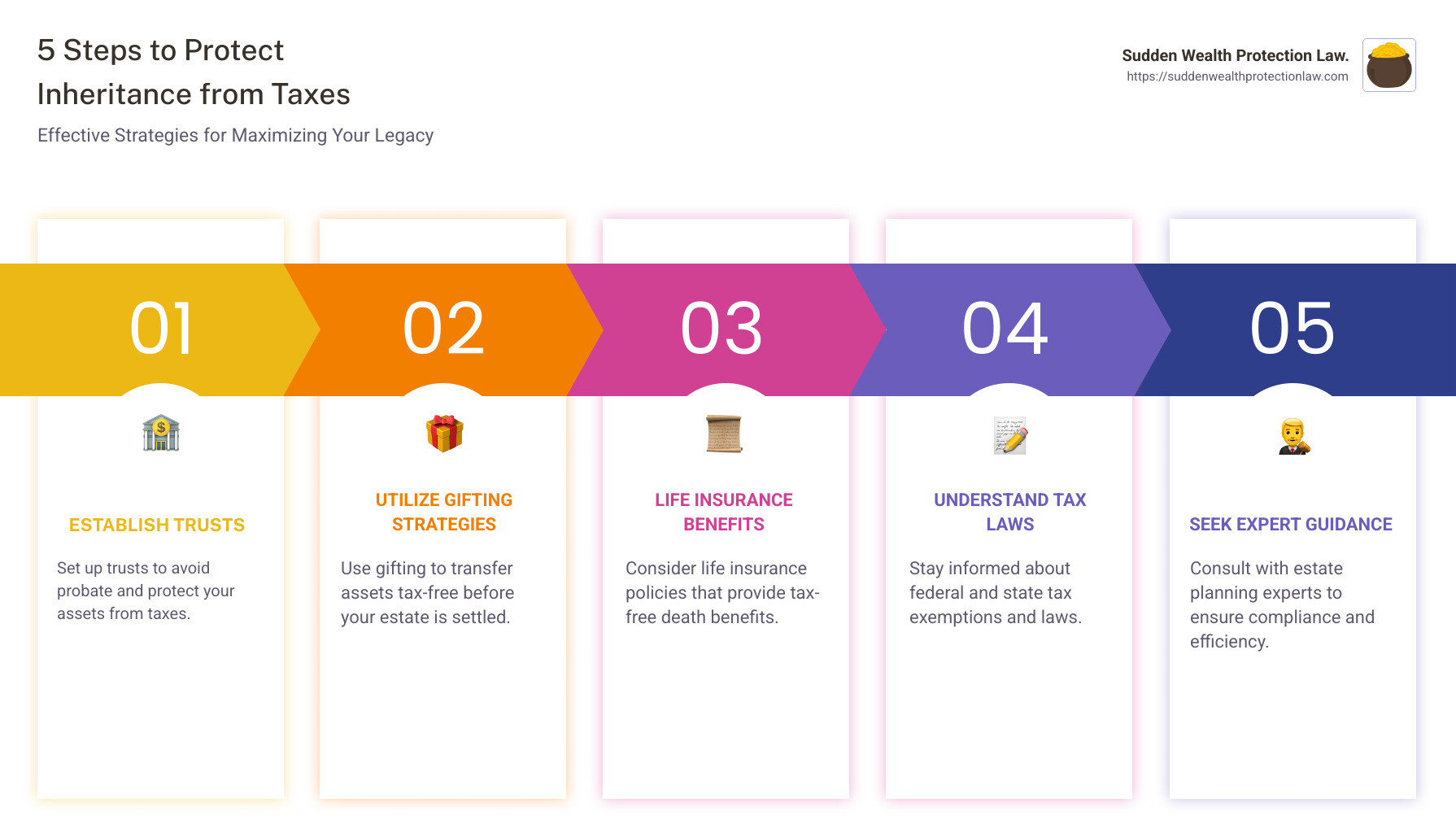
Protecting inheritance from taxes is crucial for ensuring that your loved ones receive the maximum benefit from your assets. Here are some quick pointers:
- Establish trusts to shield your assets from probate and taxes.
- Use gifting strategies to pass assets tax-free.
- Explore life insurance options to provide tax-free benefits.
Tax implications play a pivotal role in estate planning. Without proper planning, beneficiaries could face hefty taxes. The right strategies can help safeguard assets and minimize tax burdens. Plan wisely to leave a prosperous legacy without the worry of taxes diminishing your family’s inheritance.
As the founder of Sudden Wealth Protection Law, my decades of experience in protecting inheritance from taxes allow me to guide families through the complexities of estate planning. Inheriting $14 million in 2009 taught me valuable lessons that I now share with others to help them preserve their wealth.
Learn more about Protecting inheritance from taxes:
– Advanced estate planning strategies
– Arizona estate tax exemption
– Protecting assets from creditors
Understanding Inheritance Taxes
When it comes to protecting inheritance from taxes, understanding the different types of taxes is key. Here’s a simple breakdown:
Estate Tax
The estate tax is a levy on the total value of a deceased person’s assets before they are distributed to beneficiaries. The federal government imposes this tax on estates exceeding a certain threshold. For 2024, the federal estate tax exemption is $13.61 million, meaning only estates valued above this amount are taxed. The rates range from 18% to 40%, depending on the estate’s size.
Some states also have their own estate taxes, which can add an additional layer of tax liability. For example, states like New York and Massachusetts have their own exemptions and rates. It’s important to check your state’s specific rules to understand any additional taxes that might apply.
Inheritance Tax
Unlike the estate tax, the inheritance tax is imposed on the beneficiaries who receive the inheritance. The federal government does not have an inheritance tax, but a few states do. These include Iowa, Kentucky, Maryland, Nebraska, New Jersey, and Pennsylvania. The rates and exemptions vary by state, and often depend on the relationship to the deceased. For instance, a spouse might be exempt, while a more distant relative might face a higher tax rate.
Capital Gains Tax
The capital gains tax comes into play when you sell inherited assets like stocks or real estate. If you sell an asset for more than its value at the time of inheritance, you’ll pay tax on the profit. This is known as a capital gain. For example, if you inherit a house worth $200,000 and sell it later for $300,000, you’ll pay tax on the $100,000 gain.
Capital gains taxes can be minimized through smart planning. For instance, using trusts can help manage how assets are sold and taxed, potentially reducing the tax burden on beneficiaries.

In summary, understanding the various taxes that can impact an inheritance is crucial. By knowing the differences between estate tax, inheritance tax, and capital gains tax, you can better plan to protect your inheritance from taxes. This knowledge helps ensure that your beneficiaries receive the full benefit of the assets you leave behind.
Strategies for Protecting Inheritance from Taxes
When it comes to protecting inheritance from taxes, there are several strategies that can be effective. Let’s explore some of the most common methods: trusts, gifting strategies, and life insurance.
Trusts
A trust is a legal arrangement where a trustee holds and manages assets for the benefit of the beneficiaries. Trusts can be powerful tools for minimizing taxes and avoiding probate, which is the court process of distributing a deceased person’s assets.
Irrevocable Trusts are particularly useful for tax efficiency. Once assets are placed in an irrevocable trust, they are generally removed from the taxable estate, potentially reducing estate taxes. This means the value of the trust’s assets won’t be included in your estate when calculating estate taxes. Plus, trusts can help keep your estate private and out of the public eye.
Gifting Strategy
Gifting assets during your lifetime is another effective way to reduce the size of your taxable estate and thereby lower estate taxes. The IRS allows you to gift up to $17,000 per person per year (as of 2023) without incurring a gift tax. This is known as the gift tax exclusion.
By strategically gifting assets to your heirs while you are still alive, you can transfer wealth tax-free. For instance, a married couple can gift $34,000 annually to each child or grandchild without any tax consequences. Over time, this can significantly reduce the size of your estate, potentially saving a lot in estate taxes.
Life Insurance
Life insurance can also play a crucial role in protecting inheritance from taxes. The proceeds from a life insurance policy are generally not subject to income tax, providing a tax-free benefit to your heirs.
Consider setting up an Irrevocable Life Insurance Trust (ILIT). This type of trust owns the life insurance policy, keeping the death benefit out of your taxable estate. The ILIT can then distribute the proceeds to your beneficiaries without them having to pay estate taxes.
Incorporating these strategies can help ensure that your heirs receive the maximum benefit from your estate, with minimal tax liability. By using trusts, gifting, and life insurance wisely, you can protect your legacy and provide for your loved ones effectively.
Next, we’ll explore how to use trusts for tax efficiency, focusing on how they can help avoid probate and reduce taxes even further.
Utilizing Trusts for Tax Efficiency
When considering protecting inheritance from taxes, trusts are an incredibly effective tool. They can help you manage your assets, avoid probate, and reduce tax liabilities. Let’s break down how trusts can work for you.
Irrevocable Trusts
An irrevocable trust is a type of trust that, once established, cannot be easily altered or canceled. This might sound restrictive, but it’s actually a powerful way to protect your assets from estate taxes.
By moving assets into an irrevocable trust, you effectively remove them from your taxable estate. This means they won’t be counted when calculating estate taxes, which can be a significant saving.
Irrevocable trusts also provide privacy. They keep your estate details out of the public record, unlike a will that goes through probate. This can be a huge advantage if you value confidentiality.
Probate Avoidance
Probate is the legal process of distributing a deceased person’s assets. It can be lengthy, costly, and public. Fortunately, trusts can help you avoid probate entirely.
By placing your assets in a trust, they can be transferred directly to your beneficiaries without going through probate. This not only saves time and money but also keeps your estate matters private.
For example, if you have a family business or real estate, placing these in a trust ensures they pass smoothly to your heirs. Michael Christy, regional vice president of advanced planning at Fidelity, emphasizes that having a beneficiary for accounts like 401(k)s and IRAs helps avoid accelerated distributions, which can lead to increased taxes.
Combining Trusts with Other Strategies
To maximize tax efficiency, consider combining trusts with other strategies like gifting and life insurance. This holistic approach can provide comprehensive protection and tax savings for your estate.
In summary, trusts, especially irrevocable ones, are invaluable for protecting inheritance from taxes. They offer privacy, probate avoidance, and significant tax benefits, ensuring your assets are preserved for your beneficiaries.
Next, we’ll dig into gifting assets during your lifetime and how this can be a strategic move to further reduce your estate’s tax burden.
Gifting Assets During Lifetime
Gifting assets during your lifetime is a smart move for protecting inheritance from taxes. By strategically giving away money or property, you can reduce the size of your taxable estate and potentially save your heirs from hefty tax bills later.
Gift Tax Exclusion
One of the simplest ways to transfer wealth is through the annual gift tax exclusion. As of 2023, you can give up to $17,000 per person each year without triggering any gift tax. This amount increases to $18,000 in 2024. For a married couple, this means you can jointly gift $34,000 per person in 2023, doubling the impact without any tax consequences.
Here’s how it works:
- Direct Gifts: You can give cash or assets directly to your heirs. This reduces your estate and helps them financially without any tax burden.
- Educational and Medical Expenses: Pay tuition or medical bills directly to the provider. These payments don’t count against your annual exclusion limit.
Charitable Donations
Donating to charity is another effective way to lower your taxable estate. Not only do you support causes you care about, but you also gain tax benefits.
-
Donor-Advised Funds (DAFs): Contribute to a DAF and receive an income tax deduction for the year you make the donation. The assets in the DAF can be distributed to charities over time, allowing you to plan your giving.
-
Appreciated Assets: Donate stocks or mutual funds that have increased in value. You can deduct their fair market value without paying capital gains tax on the appreciation.
Charitable donations can also reduce estate taxes. Assets left to a qualified charity upon death are deducted from your taxable estate, helping to lower the overall estate tax liability.
Combining Gifting with Other Strategies
To maximize the benefits, consider combining gifting with other strategies like trusts and life insurance. This comprehensive approach can significantly reduce your estate’s tax burden and ensure your wealth is transferred smoothly to the next generation.
In summary, gifting assets during your lifetime is a powerful strategy for protecting inheritance from taxes. It allows you to share your wealth now, reduce your taxable estate, and support your loved ones and favorite causes. Next, we’ll explore how life insurance and annuities can further secure your estate plan.
Life Insurance and Annuities
Life insurance and annuities are valuable tools for protecting inheritance from taxes. They provide financial security and can be structured to minimize tax burdens on your heirs.
Death Benefit
A life insurance policy typically offers a death benefit, which is a sum paid to your beneficiaries upon your passing. The key advantage? This benefit is generally not subject to income tax, offering a tax-free financial cushion to your loved ones.
-
Lump Sum Payment: Beneficiaries often receive the death benefit as a lump sum, providing immediate funds to cover expenses or invest as they see fit.
-
Installment Options: Some policies allow the death benefit to be paid in installments, which can offer a steady income stream over time.
Irrevocable Life Insurance Trust (ILIT)
An Irrevocable Life Insurance Trust (ILIT) is a strategic way to manage life insurance policies while reducing estate taxes. By placing your life insurance policy in an ILIT, you effectively remove it from your taxable estate.
-
Control and Flexibility: As the trust grantor, you can specify who the beneficiaries are and how they receive the benefits. This ensures the funds are used according to your wishes.
-
Estate Tax Reduction: Since the policy is owned by the trust, it is not included in your estate, potentially lowering estate tax liabilities.
-
Immediate Liquidity: Upon your passing, the trust provides liquid assets to cover estate taxes, debts, or other expenses, reducing the financial burden on your heirs.
Annuities
Annuities can also be a part of your estate planning strategy. They provide a guaranteed income stream and can be structured to minimize tax impacts.
-
Death Benefit Annuities: These annuities pay a lump sum or regular income to a beneficiary upon the annuitant’s death. Although subject to taxes, they can be structured to lessen the tax load.
-
Joint-and-Survivor Annuities: These ensure income continues for a surviving spouse, which can be a crucial financial safety net.
By integrating life insurance and annuities into your estate plan, you can provide tax-free benefits and financial stability to your heirs. Next, we’ll dig into how Sudden Wealth Protection Law can offer personalized solutions to safeguard your inheritance.
Protecting Inheritance from Taxes with Sudden Wealth Protection Law
When it comes to protecting inheritance from taxes, Sudden Wealth Protection Law offers personalized legal solutions custom to your needs. If you’re in Arizona, understanding state-specific estate planning is crucial. Here’s how we can help:
Personalized Legal Solutions
Every family is unique, and so is every estate. We focus on creating customized plans that fit your specific situation. Our team of experts will guide you through the complexities of estate planning, ensuring that your wealth is transferred efficiently and with minimal tax impact.
-
Custom Strategies: We analyze your assets and develop strategies that align with your goals. Whether it’s setting up a trust or optimizing your gifting strategy, we ensure your plan is as tax-efficient as possible.
-
Comprehensive Support: From drafting wills to establishing trusts, we cover all aspects of estate planning. Our aim is to provide peace of mind by safeguarding your legacy.
Arizona Estate Planning
Arizona has its own set of rules and regulations regarding estate and inheritance taxes. Navigating these can be tricky without the right guidance.
-
State-Specific Knowledge: Our attorneys are well-versed in Arizona’s laws. We ensure your estate plan complies with all state regulations, avoiding potential pitfalls.
-
Probate Avoidance: Probate can be a lengthy and costly process. We help you set up mechanisms like living trusts to bypass probate, saving time and money for your heirs.
-
Tax Implications: While Arizona does not have an estate tax, understanding how federal estate taxes might apply is crucial. We keep you informed about any changes in tax laws that could affect your estate.
By partnering with Sudden Wealth Protection Law, you gain access to a team dedicated to preserving your wealth and easing the tax burden on your heirs. Our expertise in Arizona estate planning ensures that your legacy remains intact for future generations.

Next, we’ll address some frequently asked questions about inheritance taxes to further clarify how you can protect your assets.
Frequently Asked Questions about Inheritance Taxes
How to avoid taxes on an inheritance?
Avoiding taxes on an inheritance can seem daunting, but there are effective strategies to consider. Trusts are a popular tool. They allow you to transfer assets to beneficiaries without going through probate, which can help reduce tax liabilities. An irrevocable trust, for instance, can remove assets from your taxable estate, offering potential tax savings.
Another strategy is gifting. You can give away assets during your lifetime up to the annual gift tax exclusion limit. For 2024, this limit is $18,000 per person. This reduces the size of your taxable estate, helping minimize estate taxes.
Do I have to report inheritance money on my tax return?
Generally, inheritances are not considered income and don’t need to be reported on your tax return. However, any earnings from inherited assets, like interest or dividends, are taxable. If you inherit a retirement account, like a traditional IRA, withdrawals will be taxed as income.
Capital gains taxes come into play if you sell inherited assets, such as stocks or property, for more than their value at the time of inheritance. The difference is taxable as a capital gain.
How much can you inherit without paying federal taxes?
The federal estate tax exemption determines how much you can inherit without paying taxes. As of 2024, estates valued under $13.61 million are exempt from federal estate taxes. This threshold is set to change with inflation adjustments, so staying informed is crucial.
For most people, this exemption means they won’t face federal estate taxes. However, high-value estates should plan ahead to minimize potential tax liabilities. Utilizing estate planning tools like trusts and gifting can help keep your estate under the exemption limit.
In the next section, we’ll explore how Sudden Wealth Protection Law can assist you with personalized strategies to safeguard your inheritance from taxes.
Conclusion
Planning for the future can be overwhelming, especially when it comes to protecting inheritance from taxes. At Sudden Wealth Protection Law, we understand the complexities involved and are here to provide peace of mind through expert guidance.
Our team, led by founding attorney Paul Deloughery, specializes in Arizona estate planning. We offer personalized legal solutions custom to your family’s unique needs. Our compassionate approach ensures that your assets are protected and your legacy is preserved.
One of our key strategies is the Asset Vault Trust, an irrevocable trust designed to offer maximum flexibility and protection. This trust can help reduce tax liabilities and ensure that your wealth is transferred efficiently to your heirs.
By working with us, you can rest easy knowing that your estate plan is in capable hands. We are committed to empowering families to make informed decisions, ensuring long-term financial security and peace of mind.
For more information on how we can assist with your estate planning needs, visit our Asset Protection page. Let us help you steer the complexities of estate planning, so you can focus on what truly matters—your family’s future.

