

The Upfront Price vs. The Final Tab: Understanding Estate Planning Costs
The cost of living trust vs will isn’t just about what you pay your attorney today—it’s about what your family will pay (in dollars, time, and stress) after you’re gone.
Quick Answer: What’s the Real Cost?
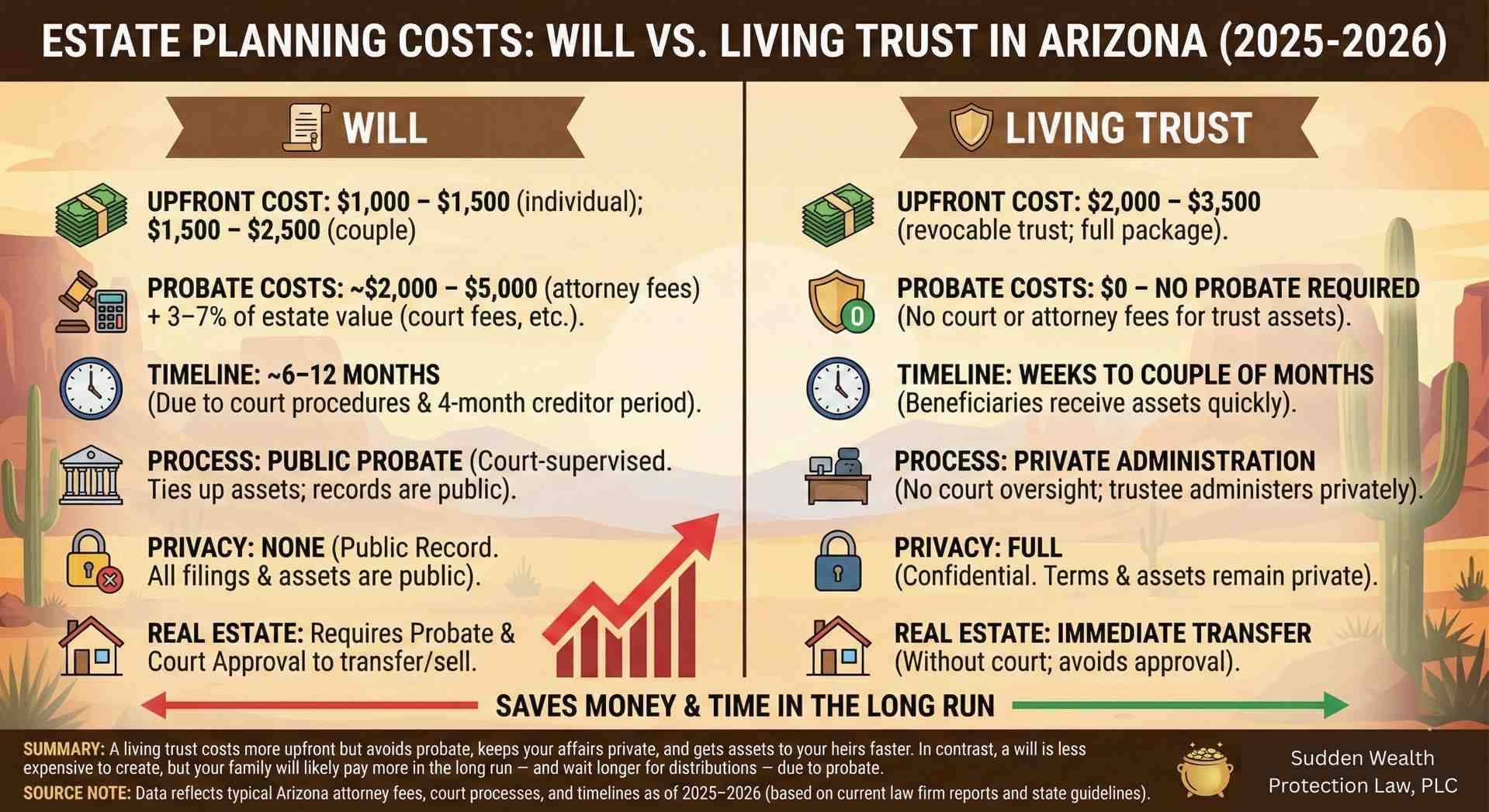
| Estate Planning Tool | Upfront Cost (Arizona) | Post-Death Cost | Timeline | Privacy |
|---|---|---|---|---|
| Will-Based Plan | $1,000–$2,500 | $2,000–$5,000+ (probate attorney fees, court costs) | 6–12 months minimum | Public record |
| Living Trust Plan | $2,500–$5,000 | Minimal (no probate required) | Weeks to a few months | Private |
Here’s the gut punch most families don’t see coming: that “cheaper” will you paid $1,500 for? It can cost your kids $5,000 in probate fees, a year of waiting, and the indignity of having your entire estate laid out in public court records for anyone to read.
I’ve watched families tear themselves apart over estates that could have been settled in a month, while courthouse vultures—creditors, scammers, and opportunists—pore over public probate files to see who just inherited what.
If you want a sense of how public probate really is, even Wikipedia’s article on probate makes it clear: it is a court process, on the record, and open to inspection.
The problem: Most people fixate on the upfront bill and ignore the final tab their family will pay.
The mistake: Choosing a will simply because it’s cheaper today, without understanding Arizona’s probate costs, timeline, and public exposure.
The reality: In Arizona, probate routinely consumes 3-7% of an estate’s value and takes 6-12 months minimum. (Arizona does not have probate fees based on a percentage. This is just a very rough estimate.) A $300,000 estate can easily lose $5,000–$12,000 to probate costs. A living trust costs more upfront but saves your family thousands in the end—and gets assets to them in weeks instead of a year.
This isn’t about selling you the most expensive option. It’s about showing you the real cost of dying with a will versus a trust in Arizona, so you can make an informed choice for your family.
I’m Paul E. Deloughery, founder of Sudden Wealth Protection Law. I’ve spent over 25 years helping Arizona families understand the cost of living trust vs will. Let me break down what you’re actually paying for—and what your family will face after you’re gone.
Now let’s dig into what happens after those documents are signed—and where the real costs show up.
What Are You Actually Paying For? Will vs. Living Trust Fundamentals
Understanding your estate planning tools is critical. The fundamental difference between a will and a living trust boils down to this: one is a death note for the court, and the other is a private rulebook for your assets that works both during your life and after.
The biggest distinction? The probate process. If you have a will, your estate generally has to go through probate. What’s probate? It’s a court-supervised process that validates your will, pays debts, and distributes what’s left to your heirs. It’s public, it takes time, and it costs money. The process itself involves multiple steps: filing a petition with the court, formally appointing an executor, notifying all heirs and creditors, creating a detailed inventory of all assets, paying all outstanding debts and taxes from the estate, and only then, after months of administrative work and waiting periods, finally distributing the remaining property to your beneficiaries.
A living trust, on the other hand, is a separate legal entity you create during your lifetime. You transfer your assets into this trust, and it holds them for your chosen beneficiaries. Because the trust already owns the assets, they don’t need to go through probate after you die. This means privacy, speed, and often, significant cost savings.
Beyond death, there’s the critical issue of incapacity planning. A will only kicks in upon your death. If you become unable to manage your own affairs due to illness or injury, a will does absolutely nothing. Your family would be forced to go to court to establish a conservatorship, a public proceeding where a judge decides who will manage your finances. This process is expensive, time-consuming, and can be deeply stressful for your loved ones. A living trust, however, already has your instructions built in. It appoints a successor trustee to step in and manage your assets according to your rules, avoiding a costly and public guardianship or conservatorship proceeding. It’s the difference between a private hand-off and a public spectacle.
A Will: Your Letter to the Probate Judge
Think of a will as your last letter to the probate judge. It only takes effect at your death, and its primary purpose is to tell the court how you want your stuff divided.
- Takes effect at death: Until you’re gone, it’s just a piece of paper.
- Must go through probate: This is the court process we just talked about. It’s the gatekeeper for your assets.
- Becomes public record: Once filed with the court, your will and the details of your estate become public information. Anyone can go down to the courthouse and read it.
- Names an executor: This is the person you designate to manage your estate through probate.
- Names guardians for minor children: This is one of the most crucial functions of a will, especially for parents. A trust cannot name a legal guardian for your children; only a will can. For more on this, check out our guide on a Last Will & Testament in Arizona.
- Can be contested: Because it goes through a public court process, a will is more susceptible to challenges from disgruntled heirs or creditors.
A Living Trust: Your Private Plan for Life and Death
A living trust is like building a private road for your assets, bypassing the public highway of probate. It’s a more robust and flexible tool than a will for managing your wealth.
- Takes effect immediately: The moment you sign it and transfer assets into it, it’s operational. You typically serve as your own trustee, managing your assets just as you did before.
- Avoids probate for funded assets: Any assets properly transferred into your trust before you die bypass the probate court entirely. This is the big one for saving time, money, and privacy.
- Manages assets during incapacity: If you become unable to manage your own affairs, your chosen successor trustee steps in seamlessly, without court intervention, to manage the trust assets for your benefit.
- Remains private: The trust document and its administration are private matters between your trustee and beneficiaries. No public records for nosy neighbors or opportunistic creditors to browse.
- Names a successor trustee: This person steps into your shoes to manage the trust if you become incapacitated or pass away. They don’t need court approval to act.
The Ultimate Breakdown: Cost of Living Trust vs Will in Arizona
Let’s cut to the chase about the cost of living trust vs will in Arizona. Many people look at the upfront price tag and stop there. That’s a rookie mistake. The real bill for your estate plan isn’t paid when you sign the documents; it’s paid by your family when you’re gone.

Choosing between a will and a living trust isn’t just about the initial investment. It’s about weighing a smaller upfront cost against a potentially massive future expense for your loved ones. The factors influencing these costs are the complexity of your estate, where your assets are located, and the experience of the attorney you choose.
Upfront Costs: The Initial Investment
Here’s what you can generally expect for the initial setup in Arizona:
- Will-based plan cost in Arizona: A plan centered on a last will, plus powers of attorney and healthcare directives, is the lower-cost option upfront. For an individual, expect around $1,000–$1,500. For a couple, it’s roughly $1,500–$2,500.
- Living trust plan cost in Arizona: A comprehensive trust-based plan is more involved, often ranging from $2,500 to $5,000, depending on complexity. This higher cost reflects the detailed legal work required to create a customized plan. It includes an in-depth consultation, the drafting of the trust itself, a pour-over will, durable powers of attorney, and crucially, guidance on funding the trust by retitling assets. You’re paying for a complete system, not just a single document.
Key takeaway: A trust costs more upfront, but this investment is designed to save your family significant money and time by avoiding probate later.
After-Death Costs: Where the Real Bill Comes Due
This is where the rubber meets the road, and where the “cheaper” option often ends up costing your family dearly.
Probate Costs for a Will-Based Estate in Arizona (Attorney Involved):
If your estate plan relies on a will, assets in your name will likely go through probate in Arizona. This process usually requires an attorney.
- Attorney Fees: Arizona law requires attorney fees to be “reasonable,” not a set percentage of the estate. For a straightforward probate, this often means $2,000 to $5,000. For more complex estates, fees can easily reach $5,000–$12,000 or more. In total, probate can consume 3%–7% of an estate’s value. (Again in Arizona, probate fees are not based on the size of the estate. This is just a rough estimate.)
- Personal Representative Fees: The person administering the estate (your personal representative) is entitled to “reasonable compensation” by law (A.R.S. § 14-3719), though family members often waive this fee.
- Court Costs & Other Expenses: Expect a few hundred dollars in court filing fees (around $175–$400, varying by county), plus potential costs for publishing notices to creditors, formal appraisal fees for real estate or businesses, and potentially a surety bond premium, which the court may require to insure the executor’s performance.
Bottom line: With a will, expect to spend several thousand dollars on probate after death for a typical estate.
Living Trust Avoids Probate: Costs After Death:
With a properly funded living trust, formal probate is not required for trust assets. This means no court supervision and usually no need to hire a probate attorney.
- Trust administration costs: There are no court fees. The trustee might consult a lawyer for guidance on their duties, but this is typically far less expensive than a full probate case. Many families incur little to no attorney expense.
- Trustee Compensation: A private trustee is entitled to reasonable compensation, but an heir serving as trustee often chooses not to take a fee.
- Asset Transfer Costs: There might be minor expenses like recording a new deed, but these are nominal.
In sum: A living trust front-loads the expense but saves your estate thousands in probate costs that a will-based plan would incur.
The Timeline Tax: How Long Your Family Waits
Beyond the dollar figures, there’s the emotional and practical cost of delay.

- Probate Timeline (with a Will): In Arizona, even a simple, informal probate takes 6–12 months minimum. This includes time for appointing a personal representative, inventorying assets, and a mandatory creditor claim period. Imagine your family needing funds to pay your mortgage or other bills, but the money is locked up by the court system. Complex or contested estates can drag on for years, leaving beneficiaries waiting and financially strained.
- Living Trust Timeline: A trust settlement is much faster, as there is no court-imposed waiting period. The successor trustee can begin managing and distributing assets within weeks. Most trusts are settled in a month or two, getting assets to loved ones quickly and reducing their stress during a difficult time.
Comparison – Timeline: Living Trust: weeks or a couple of months vs. Will/Probate: typically 6–12 months or more. The trust route spares your family the prolonged court process.
Beyond the Price Tag: Key Factors That Tip the Scales
Now that we’ve laid out the raw numbers, let’s talk about the other crucial factors that push people towards one option or the other. It’s not just about the cost of living trust vs will; it’s about your life, your family, and your peace of mind.
- Estate size matters: If your estate is small enough to fall under Arizona’s small estate affidavit limits (as of September 26, 2025, these are $200,000 for personal property and $300,000 for real property), a will might be sufficient as a simplified process can be used. But if you’re above those thresholds, probate is likely.
- Family dynamics: Do you have a blended family, children from previous marriages, or complex distribution wishes? A trust offers far greater control and flexibility to steer these sensitive situations and avoid disputes. For blended families, this can be a game-changer.
- Privacy concerns: As we’ve discussed, wills are public. Trusts are private. If you don’t want your assets, debts, and beneficiaries laid bare for public consumption, a trust is your only option.
- Real estate ownership: If you own real estate in Arizona, putting it into a living trust is one of the most effective ways to avoid probate. If you own property in multiple states, a trust is practically essential. Without it, your family must open a separate probate case in each state where you own property, a process called “ancillary probate.” This multiplies the cost, time, and hassle exponentially, requiring them to hire multiple lawyers. A trust consolidates all properties under one umbrella, allowing your successor trustee to manage them without any court involvement.
- Business ownership: For business owners, a trust can provide critical continuity. Without a trust, authority over the business is frozen until the probate court appoints an executor. During this gap, no one may have the legal authority to make payroll, sign contracts, or access business accounts. This paralysis can cripple a business. A trust allows your successor trustee to step in immediately, ensuring operations continue smoothly and preserving the business’s value.
- Incapacity planning: This is a big one. A will does nothing if you become incapacitated. A living trust ensures someone can step in immediately to manage your finances and care without the need for a court-appointed guardianship.
When a Simple Will Might Be Enough
Look, not everyone needs a Cadillac of an estate plan. For some, a reliable pickup truck will do just fine. A simple will might be sufficient if:
- Your estate is small: If your assets comfortably fall below Arizona’s small estate affidavit limits, probate might be avoidable or significantly streamlined.
- Your primary goal is naming guardians: If you have minor children, a will is absolutely essential to name their legal guardians. This is a function a trust cannot perform.
- You have a simple asset structure: A few bank accounts and a car, with clear beneficiary designations, might not warrant the complexity of a trust.
- Cost is the absolute primary concern: If every dollar upfront counts and you genuinely have a very simple estate, a will is the most cost-effective initial step. Just make sure you understand the potential deferred costs for your family.
When a Living Trust is Worth Every Penny
For many Arizona families, the long-term benefits of a living trust far outweigh the higher upfront cost. It’s an investment in control, privacy, and peace of mind. A living trust is often worth every penny if:
- Avoiding Arizona probate is a priority: This is the number one reason most people opt for a trust. You want your family to avoid the delays, costs, and public nature of court proceedings.
- You own real estate: A home, rental property, or land in Arizona will almost certainly go through probate if not held in a trust or with proper beneficiary designations.
- Privacy is critical: You value confidentiality for your financial affairs and your family’s inheritance.
- You have a blended family or complex wishes: Trusts offer precise control over how and when assets are distributed, making them ideal for ensuring fairness and protecting specific beneficiaries.
- Planning for potential incapacity: You want to ensure your financial and medical affairs can be managed seamlessly if you become unable to do so, without the need for court intervention.
The Myth of “One or the Other”: Why You Often Need Both
Here’s a secret: for most comprehensive estate plans, it’s not a choice between a will or a living trust. It’s often about having both, working together like a well-oiled machine.
A common strategy involves a living trust as the primary asset distribution vehicle, combined with a “pour-over will.” This will acts as a safety net, catching any assets you might have forgotten to transfer into your trust during your lifetime and directing them to “pour over” into the trust after your death. While these forgotten assets would still need to go through probate, the pour-over will ensures they eventually end up in the trust and are distributed according to its terms.
Crucially, a will is still essential for naming guardians for minor children. A trust cannot do this. So, even with a robust living trust, a simple pour-over will ensures that your children are cared for by the people you choose, and that any overlooked assets are swept into your private trust for distribution. This integrated approach offers the best of both worlds: the probate avoidance and privacy of a trust, plus the essential guardianship provisions of a will.
Frequently Asked Questions about the Cost of Living Trust vs Will
Let’s tackle some common questions that come up when people are trying to figure out the cost of living trust vs will. These are the questions I hear most often from Arizona families, and they cut right to the core of making smart decisions.
Can I use a DIY service to save money?
You can, but you’re playing with fire. The temptation of a cheap DIY service is strong, but this is where the “penny wise, pound foolish” principle bites hardest. The risks are substantial:
- Invalid documents: Generic templates often fail to comply with Arizona’s specific legal requirements for signing and witnessing. An invalid document means your estate ends up in probate, creating the very disputes you tried to avoid.
- Unfunded trusts: A living trust is only effective if it’s “funded”—meaning you actually transfer ownership of your assets into it. DIY services often leave you to figure out this complex process. An unfunded trust is just a binder full of paper; it won’t avoid probate.
- Creating a bigger mess: The upfront “savings” are often dwarfed by the legal fees your family pays to fix a botched DIY plan. The cost of fixing mistakes is almost always higher than doing it right the first time with an experienced attorney. You’re not just buying a document; you’re buying expertise.
Does a living trust protect my assets from lawsuits?
This is a critical distinction. A standard revocable living trust, while excellent for avoiding probate, does not protect your assets from lawsuits or creditors during your lifetime. Since you retain full control, the assets are still considered yours and are vulnerable.
For individuals whose primary goal is to shield wealth from potential lawsuits, different tools are required. We offer a specialized strategy through our Asset Vault Trust. This is a type of irrevocable trust designed specifically for asset protection by placing assets beyond your direct control, making them less accessible to creditors.
So, while a living trust is a powerful tool, understand its purpose. It’s for probate avoidance and management, not asset protection from lawsuits. Different tools for different jobs.
What are the ongoing costs of maintaining a living trust?
The good news is that for a standard revocable living trust, the ongoing costs are minimal to none.
- No annual filing fees: A revocable living trust doesn’t require annual government filing fees or registrations in Arizona.
- No mandatory accounting: There’s no legal requirement for annual court accountings or audits during your lifetime.
- Costs arise when you buy/sell major assets: The primary “ongoing cost” is retitling new assets (like a new home) into the trust. This involves minor administrative effort and sometimes small recording fees (like a ~$30 deed recording fee).
Compare this to the guaranteed, significant cost of probate that a will-based plan incurs. The minimal ongoing effort for a living trust is a small price to pay for the post-death savings it provides.
Is it difficult to fund a living trust?
“Funding” a trust—the process of transferring your assets into it—is the most critical step, and a source of anxiety for many. While it requires diligence, it is a manageable process with professional guidance. It involves changing titles on assets like real estate and bank accounts from your individual name to your name as trustee of the trust. An experienced attorney provides a detailed checklist, prepares necessary documents like deeds, and gives specific instructions for each asset, making the process a series of clear steps rather than a daunting obstacle.
What if I have both a will and a trust? Which one wins?
In a well-drafted plan, they cooperate. The living trust is the main vehicle for your assets. The will, in this case a “pour-over will,” acts as a safety net. Its job is to “catch” any assets left out of the trust and direct them into it after you pass away. So, while that forgotten asset may go through probate, the will ensures it ultimately follows the distribution rules of your trust. The trust’s terms for distribution are what ultimately control your legacy. The will also serves the vital, unique role of naming guardians for minor children.
Conclusion: Making the Right Investment for Your Family’s Future
We’ve seen that while a will seems cheaper upfront, it often leaves your family with a hefty bill—in dollars, time, and emotional strain. That “cheaper” option is an illusion that defers the real cost to your loved ones, forcing them into a public, lengthy, and expensive probate process at the worst possible time.
A living trust, while requiring a larger initial investment, is an act of foresight and protection. It acts as a shield, protecting your family from the probate court system and ensuring a swift, private, and seamless transfer of your legacy. It’s an investment in peace of mind, not just for you today, but for those you leave behind tomorrow. The choice is clear: pay a little more now to build a private bridge for your family, or save a little now and leave them to navigate the public, toll-heavy road of probate.
At Sudden Wealth Protection Law, we provide expert guidance custom to your needs, helping you make an informed decision that aligns with your goals. We don’t want you to leave a legacy of legal battles and court fees; we want you to leave a legacy of care and foresight. Take control of your estate plan and make the investment that secures their future and your peace of mind.
Learn more about creating an Arizona Revocable Living Trust.

