

Understanding the Power to Choose: Navigating Power of Attorney
A power of attorney is a legal document that allows someone else to act on your behalf.
When life throws unexpected challenges your way, who will speak for you if you can’t speak for yourself? This is where a power of attorney becomes invaluable. This essential legal document isn’t just paperwork—it’s peace of mind in writing.
A power of attorney (POA) grants someone you trust the legal authority to make decisions on your behalf when you’re unable to do so. Think of it as appointing your personal advocate who’ll ensure your wishes are honored when you can’t express them yourself.
| What is a Power of Attorney? | Quick Facts |
|---|---|
| Definition: | Legal document authorizing someone to act on your behalf |
| Key Roles: | Principal (you) and Agent/Attorney-in-fact (your representative) |
| Main Types: | General, Limited, Durable, Springing, Medical, Financial |
| When Used: | During incapacity, absence, or specific circumstances |
| Requirements: | Adult principal with sound mind, written document, proper execution |
Without a power of attorney, your family could face a challenging reality if you become incapacitated. They might need to petition the court for guardianship—a process that can be lengthy, expensive, and emotionally draining. Your POA acts as a shield against this scenario, ensuring someone you’ve personally chosen can step in to handle your affairs according to your wishes.
You might be wondering if you really need a power of attorney right now. The truth is, having this document in place is prudent if you:
Want to prepare for the unexpected. None of us can predict when illness or injury might strike, leaving us temporarily or permanently unable to manage our own affairs.
Travel frequently or work in high-risk environments. Your designated agent can handle urgent matters at home while you’re away or unable to do so.
Own property or businesses that require consistent management and quick decision-making.
Have dependents who rely on your financial support. A POA ensures their needs continue to be met even if you’re incapacitated.
Are entering your senior years and want to ensure a smooth transition of responsibilities if needed.
I’ve seen how proper planning makes all the difference. As Paul E. Deloughery, founder of Sudden Wealth Protection Law, I’ve guided hundreds of Arizona families through establishing effective powers of attorney. Over my 25+ years of experience, I’ve witnessed how these documents can prevent financial catastrophe and provide genuine comfort during difficult times.
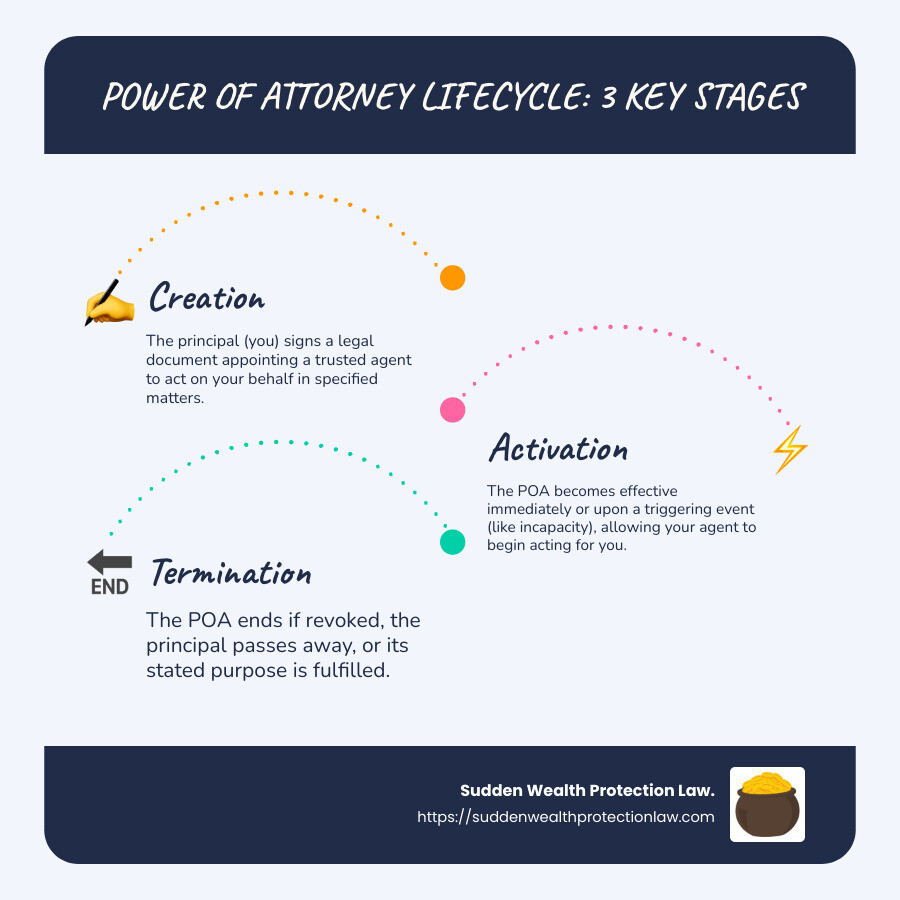
A power of attorney isn’t just for the elderly or ill—it’s for anyone who wants to protect their interests and loved ones. The document establishes a clear legal foundation for someone to act on your behalf, whether that involves accessing your bank accounts to pay bills, making healthcare decisions, or managing your property.
For more information on related topics, you might find these resources helpful:
– Planning for incapacity in Arizona
– What is a legal guardian
Creating your power of attorney doesn’t have to be complicated, but it does need to be done correctly to ensure it serves its purpose when needed most. In the following sections, we’ll explore the different types of POAs and help you determine which options best suit your unique situation.
Power of Attorney Basics
Think of a power of attorney as a relationship, not just a piece of paper. It creates a special bond between two people: you (the principal) and someone you trust (your agent or attorney-in-fact). When you create this document, you’re essentially saying, “I trust this person to handle my affairs if needed.”
This relationship comes with serious responsibilities. Your agent isn’t just your representative—they become your fiduciary, legally obligated to put your interests above their own. This fiduciary duty is the cornerstone of the entire arrangement.
“A ‘power of attorney’ is a document that gives someone legal authority to act for another person.”
For a power of attorney to be valid, you must understand what you’re signing. This means you need the mental capacity to comprehend:
– What property you own
– Who your natural beneficiaries would be
– What decisions you’re authorizing
– How these elements fit together in your overall plan
Most states follow something called the “equal dignity rule,” which means your power of attorney must be executed with the same formalities as the tasks it authorizes. For instance, if you’re giving your agent the power to sell your house, the document needs to be notarized because real estate transactions require notarization.
One of the greatest benefits of a power of attorney is that it helps you avoid guardianship or conservatorship—court processes that can be expensive, time-consuming, and very public. As one of my colleagues puts it: “If you don’t create a power of attorney in advance, a friend or family member might have to go to court to have a guardian appointed if you become incapacitated—a process that can be lengthy, expensive, and very public.”
| Feature | Power of Attorney | Guardianship/Conservatorship |
|---|---|---|
| Initiation | Voluntarily created by principal | Court proceeding required |
| Cost | Relatively inexpensive | Costly court fees and attorney expenses |
| Privacy | Private document | Public court record |
| Flexibility | Customizable powers | Court-determined authority |
| Timing | Quick to establish | Can take months to establish |
| Oversight | Limited unless specified | Regular court supervision |
| Revocation | Can be revoked by principal | Requires court approval to terminate |
Principal & Agent Roles in a Power of Attorney
Creating a power of attorney establishes a relationship with clear expectations for both parties involved. Understanding these roles helps ensure the arrangement works as intended.
As the principal, you’re in the driver’s seat. You choose who will represent you, what powers they’ll have, and when those powers begin and end. Even after your power of attorney is active, you can continue managing your own affairs as long as you’re able, and you can revoke the document if you change your mind (assuming you still have capacity).
Your agent steps into a position of tremendous trust. They must act with complete loyalty to you, making decisions based solely on what’s best for you—not what’s convenient or beneficial for them. They need to keep meticulous records of everything they do on your behalf and must never mix your property with their own.
The authority you grant can be as broad or limited as you wish. Your agent might handle your banking, investments, bill payments, tax filings, real estate transactions, business operations, government benefits applications, or even make gifts if you specifically authorize this.
Maryland’s law provides an excellent example of the high standards agents must meet. Maryland Code, Estates & Trusts § 17-113 states: “Agents must act loyally for the benefit of the principal’s best interest and cooperate with the person who is empowered to make health-care decisions.”
Good record-keeping protects everyone involved. Your agent should maintain detailed documentation of all transactions, keep receipts, document investment decisions, and save communications with banks and other institutions. These records aren’t just busywork—they’re proof that your agent fulfilled their duties properly.
When a Power of Attorney Takes Effect
Timing is everything with a power of attorney. You have options for when your document springs to life, and choosing the right timing mechanism ensures it works when you need it—and only when you need it.
The simplest approach is the immediate effect power of attorney. As soon as you sign it (with proper witnesses and notarization), your agent can begin acting on your behalf. This worries some people, but remember three important safeguards: you can still manage your own affairs, you can revoke the document anytime while competent, and your agent must always act in your best interest.
If you’re not comfortable with immediate authority, consider a “springing” power of attorney that activates only when a specific event occurs—typically your incapacity. The challenge here is defining exactly what constitutes incapacity and how it will be determined. Your document might require certification from two physicians stating you can no longer manage your affairs, or perhaps a determination by family members you trust.
For example, your springing POA might include language like: “This Power of Attorney shall become effective upon my incapacity, which shall be determined by written certification from two licensed physicians that I am unable to manage my financial affairs.”
Beyond incapacity, other triggering events might include:
– When you’re away from home (during military deployment or extended travel)
– On a specific date or during a defined period
– Under particular circumstances (such as hospitalization lasting more than two weeks)
One practical consideration: banks and other financial institutions sometimes hesitate to accept springing powers of attorney because they must verify the triggering event has occurred. This verification can create delays when your agent needs to act quickly on your behalf.
Types of Power of Attorney & Key Decision Factors
When creating a power of attorney, you’ll need to decide which type best suits your needs. Each type serves different purposes and grants different levels of authority. Think of these documents as tools in your legal toolkit – you’ll want to select the right one for the job at hand.

General Power of Attorney
A general power of attorney is like handing someone the keys to your entire financial kingdom. It grants broad authority to your agent to handle almost all your legal and financial matters. Your trusted agent can manage bank accounts, buy or sell real estate, operate your business, file your taxes, and apply for government benefits on your behalf.
This comprehensive document is particularly useful when you need someone to manage all your affairs during extended travel or when facing declining health. Just remember, a general POA ends if you become incapacitated unless it includes “durable” provisions (more on that shortly).
I’ve seen many clients feel tremendous relief knowing a trusted family member can step in and handle their affairs seamlessly when needed. However, this broad authority requires absolute trust in your chosen agent.
Limited/Special Power of Attorney
Not ready to hand over the entire kingdom? A limited (or special) power of attorney might be more your style. This document restricts your agent’s authority to specific tasks, transactions, or time periods.
For example, you might create a limited POA authorizing your sister to sell your vacation property in Flagstaff while you’re working overseas. The document might state: “I authorize my agent to sell my property at 123 Pine Street, Flagstaff, AZ, and to execute all documents necessary to complete this transaction.”
Limited POAs provide peace of mind because they confine authority to exactly what you specify – nothing more, nothing less. They’re perfect for one-time transactions or temporary situations when you need someone to act on your behalf.
Durable Power of Attorney
A durable power of attorney contains special language ensuring it remains valid even if you become incapacitated. Without this durability provision, a standard POA automatically terminates when you can no longer make decisions – precisely when you might need it most!
The document typically includes language such as: “This power of attorney shall not be affected by my subsequent disability or incapacity.” In some states, like Maryland, POAs are presumed durable unless the document explicitly states otherwise.
Most of my clients choose durable powers of attorney because they provide continuous protection regardless of what happens to their mental capacity. It’s like an insurance policy that kicks in exactly when you need it most.
Springing Power of Attorney
If you’re uncomfortable granting immediate authority, a springing power of attorney might be the answer. This type only “springs” into effect when a specified event occurs, typically your incapacity.
For example, your document might state: “This Power of Attorney shall become effective only if my attending physician certifies in writing that I am unable to manage my financial affairs.” This gives you complete control until you genuinely need assistance.
While this sounds ideal in theory, springing POAs come with practical challenges. Financial institutions often hesitate to accept them because they must verify the triggering event has occurred, which can cause frustrating delays when your agent needs to act quickly.
Medical/Healthcare Power of Attorney
A medical power of attorney addresses your healthcare rather than financial matters. This crucial document appoints someone to make medical decisions if you become unable to communicate your wishes.
Your healthcare agent can consult with doctors, access your medical records (with proper HIPAA authorization), make treatment decisions, and ensure your end-of-life wishes are respected. Without this document, doctors may be unable to share information with your loved ones due to privacy regulations, leaving your family in a difficult position during medical emergencies.
Many clients combine their healthcare POA with a living will or advance directive that specifies their wishes regarding life-sustaining treatment. Together, these documents create a comprehensive plan for your medical care if you can’t speak for yourself.
Financial Power of Attorney
A financial power of attorney focuses specifically on monetary and property matters. It can be general or limited in scope and typically authorizes your agent to manage bank accounts, pay bills, handle investments, buy or sell property, and deal with insurance matters.
This document is particularly valuable for seniors who may need assistance managing daily financial affairs as they age. I’ve seen many families avoid costly guardianship proceedings because a properly drafted financial POA was in place before capacity issues arose.
Military Power of Attorney
For service members facing deployment, a military power of attorney offers special provisions related to military benefits. These POAs are recognized internationally where U.S. military bases are located, making them invaluable for service members stationed abroad who need someone to handle their affairs back home.
The military recognizes the unique challenges faced by deployed personnel and has streamlined processes for creating these documents through base legal assistance offices.
Special Forms for Specific Institutions
Some organizations require their own specialized POA forms. The IRS requires Form 2848 for an agent to represent you in tax matters. Social Security Administration uses form SSA-11 to appoint a representative payee. Veterans Affairs requires Form 21-22a for VA claims and benefits.
These institution-specific forms can’t be replaced by your general POA, so it’s important to complete them if you want your agent to handle matters with these agencies.
Gift Powers
If you want your agent to make gifts on your behalf, this power must be explicitly stated in your power of attorney. Gift powers can be important for continuing your charitable giving, estate tax planning, Medicaid eligibility planning, or supporting family members.
However, gift powers also create potential for abuse. I always advise clients to carefully limit and monitor these powers, perhaps by specifying maximum gift amounts or naming permitted recipients.
When deciding which type of power of attorney to create, consider your comfort level with granting authority, the likelihood of needing assistance, the complexity of your financial affairs, and most importantly, your trust in your chosen agent. State laws also vary significantly, so Arizona-specific guidance is essential.
Durable vs. Springing Power of Attorney
The choice between durable and springing powers of attorney represents one of the most important decisions in your planning process.
A durable power of attorney takes effect immediately upon signing and continues even if you become incapacitated. The benefits are significant: your agent can act without delay when needed, there’s no need to prove incapacity to skeptical third parties, and financial institutions generally accept them more readily. They’re especially valuable if your capacity might diminish gradually over time, as with conditions like dementia.
Many clients initially worry about signing a document that gives someone immediate authority over their affairs. I remind them that even with a durable POA in place, you can continue managing your own affairs as long as you’re able, and you retain the right to revoke the document at any time while competent.
A springing power of attorney activates only when you become incapacitated. While this preserves your complete autonomy until assistance is truly needed, it comes with significant practical challenges. There may be delays while doctors certify your incapacity, and financial institutions are often reluctant to accept them even with proper certification.
Some states, like Florida, have banned springing POAs entirely (Florida eliminated them in 2011) due to the complications they create. Banks are particularly cautious about springing POAs and may refuse to honor them even with a physician’s letter in hand.
When choosing between these options, consider your comfort level, the trustworthiness of your agent, and the types of assets you own. In my experience, most clients ultimately choose durable POAs once they understand the practical challenges of springing documents.
Medical (Healthcare) Power of Attorney
A medical power of attorney serves as your voice when you cannot speak for yourself. This document, sometimes called a healthcare POA or advance directive, appoints someone you trust to make medical decisions if you become unable to communicate your wishes.
Without this crucial document, healthcare providers may be unable to share information with your loved ones due to HIPAA privacy regulations. A proper healthcare POA includes HIPAA authorization language to ensure your agent can access your medical information when needed.
Your healthcare agent can make decisions about treatments, medications, choice of doctors, hospital care, and end-of-life wishes. Importantly, this document only activates when you cannot make or communicate decisions. As long as you’re able to decide for yourself, healthcare providers will continue consulting you directly.
I always encourage clients to have deep conversations with their chosen healthcare agents about their values and preferences. Would you want aggressive treatment in all circumstances? How do you feel about quality of life versus length of life? These conversations, while sometimes difficult, ensure your agent truly understands your wishes.
Research from the CDC confirms that advance care planning documents like healthcare POAs “provide a way for patients to communicate their wishes to family, friends, and health care professionals and to avoid confusion later on, should they become unable to do so.”
If you don’t create a healthcare POA, Arizona law designates a “surrogate decision-maker” according to a priority list starting with your spouse, then adult children, parents, and siblings. However, this person may not be who you would have chosen, and they may not know your wishes.
General vs. Limited Powers
When creating a power of attorney, you face a fundamental question: Should you grant broad authority through a general POA or restrict authority to specific matters with a limited POA?
A general power of attorney gives your agent comprehensive authority over your financial and legal affairs. It’s like appointing a financial alter ego who can step into your shoes and handle virtually any transaction you could do yourself. This includes managing all accounts, buying or selling property, running businesses, dealing with insurance, and handling taxes.
The advantage of this approach is simplicity and completeness – your agent won’t be hamstrung by limitations when trying to help you. The obvious downside is that it requires absolute trust in your agent’s judgment and integrity.
A limited power of attorney takes the opposite approach, restricting your agent’s authority to specific tasks or transactions. For example, you might authorize your daughter to sell your rental property while you’re recovering from surgery, or allow your son to access a specific investment account to make required minimum distributions.
Real estate transactions often require special attention in POAs. Many jurisdictions, including Washington D.C., require specific language in bold type authorizing real estate transactions. Without this precise language, title companies may reject the document.
I find many clients choose a middle ground, granting broad authority but excluding certain sensitive powers unless specifically authorized. For example, you might give your agent general financial powers but specifically exclude the ability to make gifts, change beneficiaries, or create trusts without explicit authorization.
At Sudden Wealth Protection Law, we help clients determine the appropriate scope of authority based on their unique situation. We can incorporate these powers into our Asset Vault Trust for maximum flexibility and protection, ensuring your affairs are managed according to your wishes while protecting your assets for the next generation.
Creating and Managing Your Power of Attorney
Creating a valid power of attorney requires careful attention to legal requirements and practical considerations. While the specific requirements vary by state, certain principles apply universally.

Drafting Your Power of Attorney
When it comes to creating your power of attorney, you have several options. Many people choose to use statutory forms provided by their state, which are designed to comply with local laws. For instance, Maryland enacted the General and Limited Power of Attorney Act in 2010, which includes ready-to-use statutory forms that financial institutions are more likely to accept.
However, these one-size-fits-all documents might not address your unique situation. That’s why many of my clients prefer a customized power of attorney that we craft together. This approach allows us to address complex assets, incorporate specific limitations, and ensure your POA works seamlessly with your overall estate plan.
Whether you choose a statutory form or a custom document, your power of attorney should clearly identify your agent and any successors, specify whether it’s durable, outline when it takes effect, detail the specific powers you’re granting, and address any limitations you want to impose. Think of it as a roadmap for your agent – the clearer the directions, the more likely they’ll steer your affairs exactly as you’d want.
Execution Requirements
A power of attorney isn’t valid until it’s properly executed according to your state’s laws. Most states require your signature as the principal, along with proper dating of the document. Many also require notarization and signatures from two adult witnesses who aren’t named as agents in the document.
The good news is that many states have acceptd technology by adopting remote online notarization (RON) laws. This means you can execute your power of attorney electronically – a tremendous help if you’re homebound or living far from notary services. I’ve seen this option provide great relief to clients who are traveling or have mobility issues.
Interstate Recognition
“What happens if I move to another state or own property in multiple states?” This is a question I hear frequently, and it’s an important consideration. While a valid power of attorney is generally recognized across state lines, requirements do vary.
If you relocate or own property in different states, I recommend reviewing your POA for compliance with each state’s laws. In some cases, it makes sense to execute a new document that specifically references the new state’s statutes. Always make sure your agent knows about any state-specific requirements – this awareness can prevent frustrating delays when they need to act on your behalf.
Digital Assets and Online Accounts
Your online life represents an important part of your assets and identity. Without specific authorization in your power of attorney, your agent may be unable to access your email, social media, digital financial accounts, online subscriptions, digital photos, or cryptocurrency holdings.
Many states have adopted the Revised Uniform Fiduciary Access to Digital Assets Act (RUFADAA), which provides a legal framework for fiduciary access to digital assets. Your power of attorney should include language that complies with this act if you want your agent to have access to your digital life. I’ve seen families struggle to access important online accounts after a loved one’s incapacity – proper planning can prevent this additional stress during an already difficult time.
Execution Checklist for a Valid Power of Attorney
To ensure your power of attorney stands up to scrutiny, follow these essential steps:
Put your POA in writing – oral powers of attorney generally aren’t recognized. Verify that you (as the principal) are at least 18 years old and mentally competent. Use clear, specific language about the powers you’re granting – this increases the likelihood that third parties will honor the document.
If you want your POA to remain effective during your incapacity, include specific durability language. Sign and date the document yourself, and obtain signatures from two adult witnesses who aren’t named as agents. While notarization isn’t always legally required, it significantly increases acceptance by third parties and is mandatory for real estate transactions in most states.
For POAs involving real estate, record the document in the county where the property is located. Make several copies for your agent, alternate agents, and key financial institutions. And remember to review your POA periodically, especially after major life changes or moves to different states.
In Maryland, for example, Estates & Trusts Code § 17-105 requires that a power of attorney be in writing, signed by the principal, acknowledged before a notary, and witnessed by two adults. Electronic execution is permissible under specified conditions, including certain executive orders and supervision by attorneys.
Duties, Limitations, and Oversight of the Agent
Your agent under a power of attorney carries significant responsibilities. They must act in your best interest, avoid conflicts of interest, keep detailed records, maintain your property separately from their own, act within their authorized scope, and follow your reasonable expectations in good faith.
As Maryland Code § 17-113 states: “Agents must act loyally for the benefit of the principal’s best interest and cooperate with the person who is empowered to make health-care decisions.”
There are important limitations on what your agent can do. They cannot change your will, make decisions after your death (except for funeral arrangements if specifically authorized), transfer their authority unless your POA explicitly permits it, act contrary to your known wishes, commingle funds, or make gifts unless explicitly authorized.
To ensure your agent acts appropriately, consider building oversight provisions into your power of attorney. You might require regular accounting to family members or a professional, name co-agents who must act jointly, require third-party approval for certain transactions, or include a “monitor” who can request information from your agent.
Your agent is generally entitled to reasonable reimbursement for expenses incurred on your behalf. Your POA can also specify whether they should receive compensation for their services – something worth discussing openly with your chosen agent before finalizing your document.
Revocation & Termination
As long as you remain mentally competent, you can revoke your power of attorney at any time. To do this properly, create a written revocation document stating that you’re revoking all previous powers of attorney, sign and date it, have it notarized, and provide copies to your former agent and any third parties who have the original POA. If your original POA was recorded (as with real estate transactions), be sure to record the revocation in the same location.
A POA automatically terminates upon your death (with limited exceptions for body disposition or organ donation), your incapacity (if the POA isn’t durable), the accomplishment of its purpose (for limited POAs), any expiration date stated in the document, or court revocation.
If your agent resigns, becomes incapacitated, or dies, your POA remains in effect but cannot be used until a successor agent (if named) takes over. Without a named successor, you may need to execute a new POA.
That financial institutions may refuse to honor a power of attorney they believe is outdated, even if it hasn’t been formally revoked. For this reason, I advise clients to periodically review and update their POAs.
At Sudden Wealth Protection Law, we can help you establish a comprehensive guardianship and conservatorship plan that works in conjunction with your power of attorney to ensure continuous protection.
Preventing Abuse & Protecting Yourself
While a power of attorney is a valuable tool, it can be misused. To protect yourself, start by selecting a trustworthy agent – someone with integrity, not just financial acumen. Consider their proximity, availability, and willingness to serve. Have an open discussion about your expectations before naming them, and make sure they understand their fiduciary duties.
Consider naming co-agents who must act jointly, providing a natural check and balance system. While this can create logistical challenges for routine transactions, the added security may be worth it. Alternatively, name a primary agent and a “monitor” who receives copies of all transactions.
Including accounting requirements in your power of attorney can add another layer of protection. Require your agent to provide regular financial reports to you or a third party, specifying how often these reports should be generated and how detailed they should be. For significant assets, professional oversight for large transactions might be appropriate.
Limiting certain powers can prevent the most common abuses. Consider excluding the power to make gifts unless necessary for tax or Medicaid planning, requiring third-party approval for self-dealing transactions, and setting dollar limits on transactions that can be made without additional approval.
A surety bond provides insurance against agent misconduct, with the premium typically paid from your funds. The bond company will investigate claims of misappropriation, adding another layer of oversight.
If abuse is suspected, interested parties can petition the court to order an accounting, suspend or terminate the agent’s authority, appoint a guardian or conservator, or order restitution of misappropriated assets. Free legal aid programs are available in most areas to help victims of POA abuse with advice, court filings, and sometimes representation.
Research from Marquette Elder’s Advisor found that “POA abuse most commonly occurs when the agent uses the principal’s property for the agent’s own benefit rather than for the benefit of the principal.” Awareness of this risk and implementing proper safeguards can significantly reduce the likelihood of abuse.
Power of Attorney in Action: Real-World Scenarios
A power of attorney isn’t just a piece of paper—it’s a powerful tool that helps real people steer challenging situations every day. Let’s look at how these documents work in actual scenarios you might encounter.

I’ve seen countless families breathe a sigh of relief when they have a power of attorney in place just when they needed it most. Take Sarah’s story, for example. When her father Robert received an early-stage dementia diagnosis, they didn’t panic. Robert had wisely created a durable financial power of attorney naming Sarah as his agent. This foresight allowed Sarah to seamlessly step in to pay his bills, manage his investments, handle his taxes, and steer the complex world of Medicare and insurance claims.
Banking situations like Sarah’s highlight an important reality: even with a legally valid power of attorney, you might encounter institutions that request their own forms. This isn’t unusual—many banks have their own requirements despite state laws mandating acceptance of valid POAs. That’s why I always advise clients to connect with their financial institutions before an emergency arises.
Using a Financial Power of Attorney with Institutions
When your agent presents your financial power of attorney to various institutions, they’ll likely encounter different requirements depending on where they go. Being prepared for these variations can save tremendous headaches.
With banks and credit unions, I recommend taking proactive steps for smoother acceptance. Provide your POA to the bank before you actually need to use it. Ask if they require supplemental forms (many do), ensure your document is relatively recent, and include specific banking powers in your POA language.
If your agent encounters resistance—which happens more often than you might think—they should politely ask to speak with the legal department. Most financial institutions will eventually accept a valid POA, especially when reminded of state laws requiring them to do so. As a last resort, legal action is possible, though rarely necessary.
For government agencies, standard POAs typically won’t suffice on their own. The IRS requires their Form 2848, which specifies exactly which tax years are covered and requires specific credentials for representatives. This form typically expires after a set period unless renewed.
Similarly, the Social Security Administration requires an agent to become a “representative payee” using Form SSA-11. This involves an in-person application and annual accounting to the SSA. The Veterans Administration has its own forms too—VA Form 21-22 for accredited representatives and VA Form 21-22a for non-accredited individuals.
To simplify matters, 28 states have now adopted universal durable power of attorney forms available online. These standardized documents increase acceptance odds, though you might still need supplemental forms for specific entities.
Healthcare Decisions & Advance Directives
Medical emergencies rarely announce themselves in advance. That’s why a healthcare power of attorney works hand-in-hand with other advance directives to ensure your medical wishes are followed when you can’t speak for yourself.
In Maryland, for example, the Advance Directive combines a healthcare POA with a living will. This comprehensive document not only names your healthcare agent but also provides crucial instructions for end-of-life care and addresses organ donation wishes. It requires two witnesses (who cannot be your named agent) but interestingly doesn’t require notarization.
The living will component is particularly important as it specifies your preferences for medical treatments if you cannot communicate. This includes your wishes regarding life-sustaining treatments, artificial nutrition, pain management, comfort care, and experimental treatments. I’ve seen the peace of mind this brings to both the person creating the document and their loved ones.
Your advance directive can also clearly state your wishes about organ donation—whether you want to donate organs for transplantation, contribute your body to medical research, specify particular organs, or set time limitations on life support for donation purposes.
When creating these important healthcare documents, take time to reflect on personal factors that might influence your decisions. Consider your religious or spiritual beliefs about end-of-life care, your personal tolerance for pain versus cognitive impairment from pain medications, and your views on quality versus quantity of life. Existing medical conditions and family medical history should also inform these important decisions.
At Sudden Wealth Protection Law, we integrate healthcare directives with our comprehensive Family Wealth Protection strategies to ensure all aspects of your wellbeing are protected.
Real Estate Transactions
Real estate matters often require special handling with a power of attorney. Consider Michael and Catherine’s situation when selling their vacation home in Arizona. Michael couldn’t attend the closing due to business commitments, but Catherine had a limited power of attorney specifically for this transaction.
At the closing table, Catherine signed: “Michael Douglas, by Catherine Zeta-Jones under POA dated June 15, 2023.” The title company required the original POA document (or a certified copy) and recorded it alongside the deed. Since this POA was created specifically for this real estate transaction, it automatically terminated once the sale completed.
Tax Matters and Government Agencies
Tax matters deserve special attention when it comes to power of attorney arrangements. Jennifer finded this when helping her mother Elena with tax issues. Jennifer quickly learned that her general power of attorney wasn’t sufficient for IRS matters—the IRS required its specific Form 2848. With this properly completed, Jennifer could represent her mother during an audit, access tax records, file returns, and negotiate payment plans if needed.
Healthcare Decisions
Medical emergencies often arrive without warning, as David finded after a serious accident. Thankfully, David had previously executed a healthcare power of attorney naming his brother Mark as his agent. This foresight allowed Mark to consult with doctors about treatment options, access medical records (thanks to HIPAA authorization language in the POA), make critical decisions about surgeries when David was unconscious, and ensure his brother’s religious preferences regarding treatments were respected.
Without this healthcare POA, doctors might have made decisions based on standard protocols rather than David’s specific wishes, and Mark would have faced significant barriers accessing information about his brother’s condition.
Interstate Moves and Validity
People move across state lines frequently, which raises questions about power of attorney validity. Lisa created her POA in California before relocating to Arizona. While her California document is generally valid in Arizona, some institutions questioned it because it didn’t follow Arizona’s statutory requirements.
To avoid these complications, I recommend reviewing your POA with an attorney in your new state, considering executing a new document under local law, and informing your agent about any differences in requirements between states.
Standby Guardianship for Children
A power of attorney can also provide crucial protection for children in uncertain situations. Maria, a single mother facing deportation proceedings, used a POA to designate her sister Ana as standby guardian for her children. This document granted Ana authority to make educational and medical decisions, access records, and enroll the children in school—all without court intervention. The arrangement remained in effect for 180 days, providing stability while Maria resolved her immigration status.
These real-world examples demonstrate why a properly executed power of attorney isn’t just a legal formality—it’s a practical tool that protects you and your loved ones when life throws unexpected challenges your way. By anticipating potential scenarios and creating appropriate POA documents custom to your situation, you can ensure your affairs will be managed according to your wishes even when you cannot manage them yourself.
Frequently Asked Questions about Power of Attorney
What happens if I become incapacitated without a power of attorney?
Life can throw unexpected curveballs at any moment. If you become incapacitated without a power of attorney in place, your loved ones face a challenging road ahead. They’ll need to petition the court for guardianship or conservatorship – a process that’s often emotionally draining and financially burdensome.
This court process typically takes several months to complete and can cost thousands of dollars in legal fees. What many people don’t realize is that all your personal and financial information becomes part of the public record. The court might appoint someone to manage your affairs whom you wouldn’t have chosen yourself, and your family will face ongoing court supervision with regular reporting requirements.
I’ve seen families struggle through this process countless times. As one client told me after going through guardianship proceedings for her mother: “If we had just gotten a power of attorney while Mom was still able to sign one, we could have avoided months of stress and thousands in legal fees.”
In Arizona, like most states, the court follows a priority list when appointing a guardian – typically starting with your spouse, then adult children, parents, and siblings. But family dynamics aren’t always simple. I’ve witnessed cases where family disagreements led to contested hearings, multiplying the emotional toll and financial costs.
How should an agent sign on my behalf?
When your agent steps in to handle matters under your power of attorney, proper signature format matters more than you might think. The right approach protects both you and your agent while clearly communicating to third parties who’s doing what.
The proper signature format should look like this:
“[Your name], by [Agent’s name], Attorney-in-Fact” or “[Your name], by [Agent’s name] under POA dated [date]”
For example: “John Smith, by Mary Jones, Attorney-in-Fact” or “John Smith, by Mary Jones under POA dated January 15, 2023”
This format does several important things: it makes clear your agent is acting on your behalf (not in their personal capacity), identifies the legal basis for their authority, protects them from personal liability, and helps organizations properly record the transaction.
Different transactions sometimes have specific requirements. For real estate deals, title companies often provide detailed instructions for POA signatures. When writing checks, your agent typically signs your name followed by their signature and “POA” or “Attorney-in-Fact.”
In my practice, I’ve seen confusion arise when agents simply sign their own name without indicating they’re acting under a POA. This can create headaches with banks and other institutions that might reject the transaction or, worse, hold the agent personally responsible.
Can a power of attorney be used in another state or country?
Life is mobile these days, and many of my clients wonder if their power of attorney will work across state lines or international borders. The good news is that a POA validly executed in one state is generally recognized in other states. However, I’ve found there are often practical challenges that catch people by surprise.
Financial institutions in a new state may be unfamiliar with another state’s requirements and question the document’s validity. Each state has its own witnessing or notarization requirements that might differ from where you created your POA. For real estate transactions, you’ll typically need to record the POA in the county where the property is located.
If you move to a new state or own property in multiple states, I recommend:
– Having your POA reviewed for compliance with the new state’s laws
– Considering a new POA that specifically references the new state’s statutes
– Making sure your agent knows about any state-specific requirements
International recognition gets even more complicated. Countries with common law systems like the UK, Canada, and Australia may recognize a U.S. POA, but civil law countries like France, Germany, and Japan often have completely different requirements.
I remember helping a client who owned a vacation property in Spain. His Arizona power of attorney wasn’t recognized by Spanish authorities, and we had to create a separate document that complied with Spanish requirements, then have it properly authenticated for international use.
If you own property or conduct business internationally, it’s worth considering:
– Creating a separate POA that complies with that country’s specific requirements
– Consulting with an attorney in that jurisdiction
– Using a local notary who can provide an apostille (international authentication)
At Sudden Wealth Protection Law, we help our clients steer these complexities by creating powers of attorney that work seamlessly with our comprehensive Asset Vault Trust. This approach gives you maximum flexibility and protection no matter where life takes you.
Conclusion
A power of attorney is one of the most important documents in your estate plan. It ensures that someone you trust can manage your affairs if you become unable to do so yourself, avoiding costly and time-consuming court proceedings.
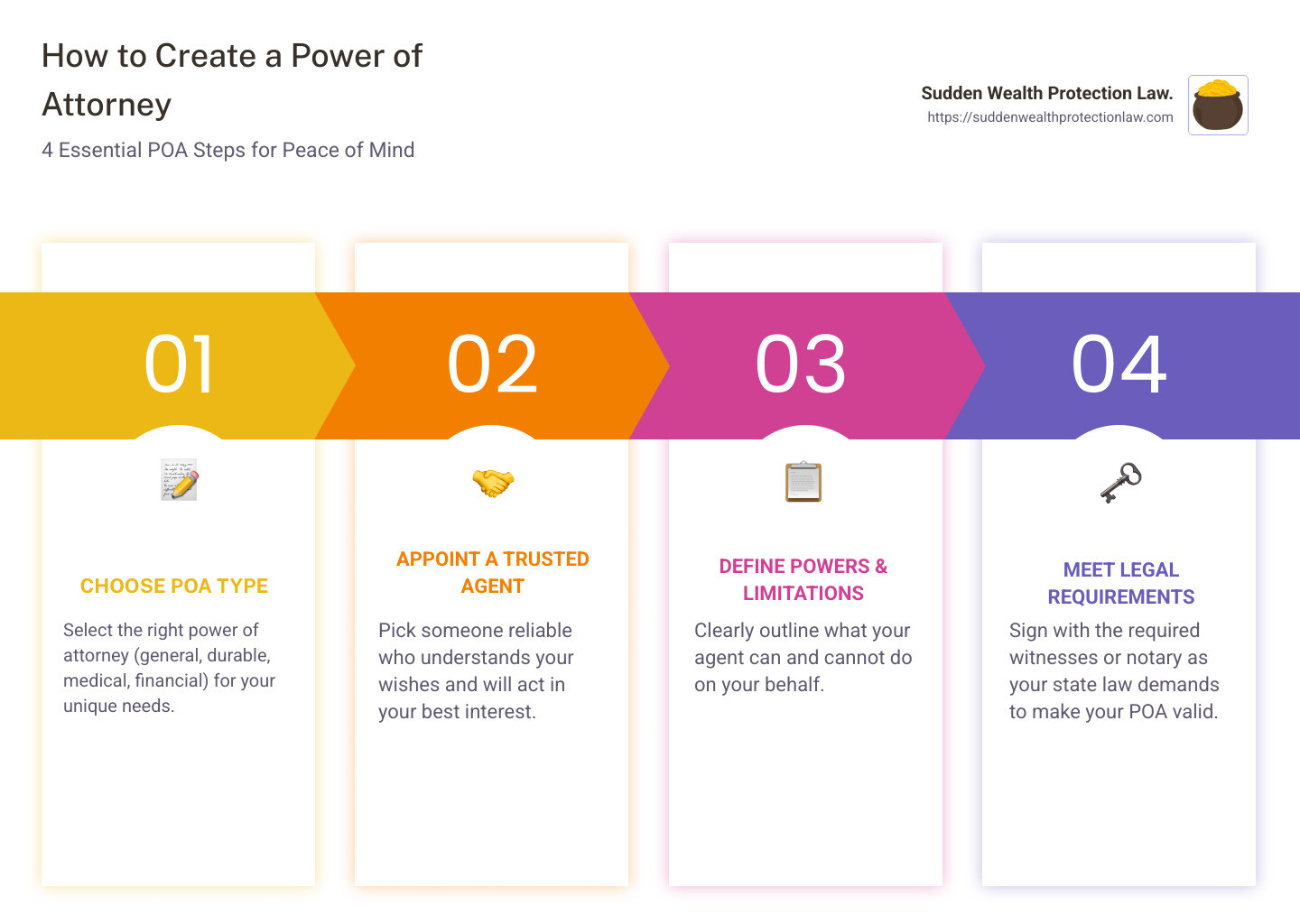
Throughout this guide, we’ve walked through the ins and outs of powers of attorney – from understanding the basic concepts to exploring different types and real-world applications. Now that you have a clearer picture, it’s time to take action.
Creating your power of attorney doesn’t need to be overwhelming. Start by choosing the right type for your situation – whether that’s a durable POA to cover potential incapacity, a healthcare POA for medical decisions, or a limited POA for specific transactions. The key is selecting a document that addresses your unique circumstances.
Your choice of agent is perhaps the most crucial decision you’ll make. This person will potentially manage your entire financial life or make life-altering medical decisions on your behalf. Choose someone who not only understands your wishes but has the capability and willingness to carry them out, even in emotionally difficult situations.
Be clear and specific about the powers you’re granting. While many people benefit from comprehensive authority, you might want to include certain limitations or oversight mechanisms for your peace of mind. Your power of attorney should grow and change with you – review it periodically, especially after major life events like marriage, divorce, or moves across state lines.
Once your document is properly executed according to your state’s requirements, don’t just file it away. Make sure your financial institutions know about it, provide copies to healthcare providers if relevant, and ensure your agent has access to the original when needed. A power of attorney locked in a safe deposit box that no one can access defeats its purpose.
At Sudden Wealth Protection Law, we understand that planning for incapacity isn’t just about legal documents – it’s about providing comfort and security for yourself and your loved ones. Our comprehensive approach integrates powers of attorney with our Asset Vault Trust, creating a protective shield around your family’s assets while maintaining the flexibility you need.
We’ve seen how proper planning spares families from painful court battles during already difficult times. The peace of mind that comes from knowing your affairs will be handled according to your wishes is truly priceless.
Don’t wait until it’s too late. Incapacity can happen suddenly and without warning, leaving your family scrambling for solutions if you haven’t prepared. Contact Sudden Wealth Protection Law today to discuss how we can help you create a power of attorney that fits seamlessly into your overall estate plan. Our compassionate, expert guidance is custom to your unique needs, ensuring favorable outcomes for you and your family.
Learn more about our Estate Planning services

