

A ward of the court is a person placed under the court’s protection because they cannot care for themselves. This legal arrangement happens when a court assumes responsibility for someone’s welfare.
What is a Ward of the Court? Quick Facts:
- Definition: A person (minor or adult) under court protection with a court-appointed guardian
- For minors: Often due to abuse, neglect, or lack of parental care
- For adults: Usually due to incapacity from disability, illness, or advanced age
- Legal basis: Derived from “parens patriae” (the state as parent) doctrine
- Not the same as: Having a legal guardian through power of attorney
The concept of wardship dates back centuries to British common law, where courts would step in to protect those unable to protect themselves. Today, this legal mechanism continues to serve as a vital safety net when individuals need protection.
Many people confuse having a legal guardian with being a ward of the court. However, a true ward of the court status requires court appointment of a guardian and, in many cases, termination of parental rights.
I’m Paul E. Deloughery, founder of Sudden Wealth Protection Law with over 25 years of legal experience helping Arizona families steer complex guardianship matters, including ward of the court proceedings where the state assumes protective responsibility over vulnerable individuals.
Ward of the court word list:
– Planning for incapacity in Arizona
– power of attorney
– what is a legal guardian
What Is a Ward of the Court?
When we talk about a ward of the court, we’re referring to someone who’s been placed under a court’s protection because they simply can’t care for themselves. This concept comes from an ancient legal principle called “parens patriae” – which essentially means “the state as parent.” This principle gives courts the authority to step in and act as guardian when someone needs protection.
Collins Dictionary puts it clearly: a ward of court is “a person—especially a minor or someone legally incapable—placed under court or guardian protection because they cannot manage their own affairs.” This captures the heart of what court wardship means.
This protective status applies to both children and adults who need help. For kids, it typically happens when parents can’t or won’t provide proper care. For adults, it usually occurs when mental or physical limitations prevent them from making their own decisions.
The concept has played interesting roles throughout American history. In the famous 1831 Supreme Court case Cherokee Nation v. Georgia, Native American tribes were legally classified as “wards of the state” – a designation that would shape federal-tribal relationships for generations to come.
Legal Definition & Historical Roots
The idea of becoming a ward of the court has deep roots in old English Chancery courts. These special courts were created specifically to protect those who couldn’t protect themselves – particularly orphaned children and people with disabilities.
This protective role is one of the oldest in common law history. It came directly from the British sovereign’s duty as “parens patriae” to look after vulnerable subjects. When American colonists built their own legal system, they brought this concept with them.
As the famous legal scholar Judge William Blackstone noted in his Commentaries on the Laws of England, the sovereign, as “pater patriae,” had the duty to protect “all persons who have no other lawful protector.” This fundamental principle still guides courts today when they take responsibility for vulnerable individuals.
In our modern legal system, wardship represents the court stepping in to take ultimate responsibility – a serious step that’s only taken when truly necessary to protect someone’s wellbeing.
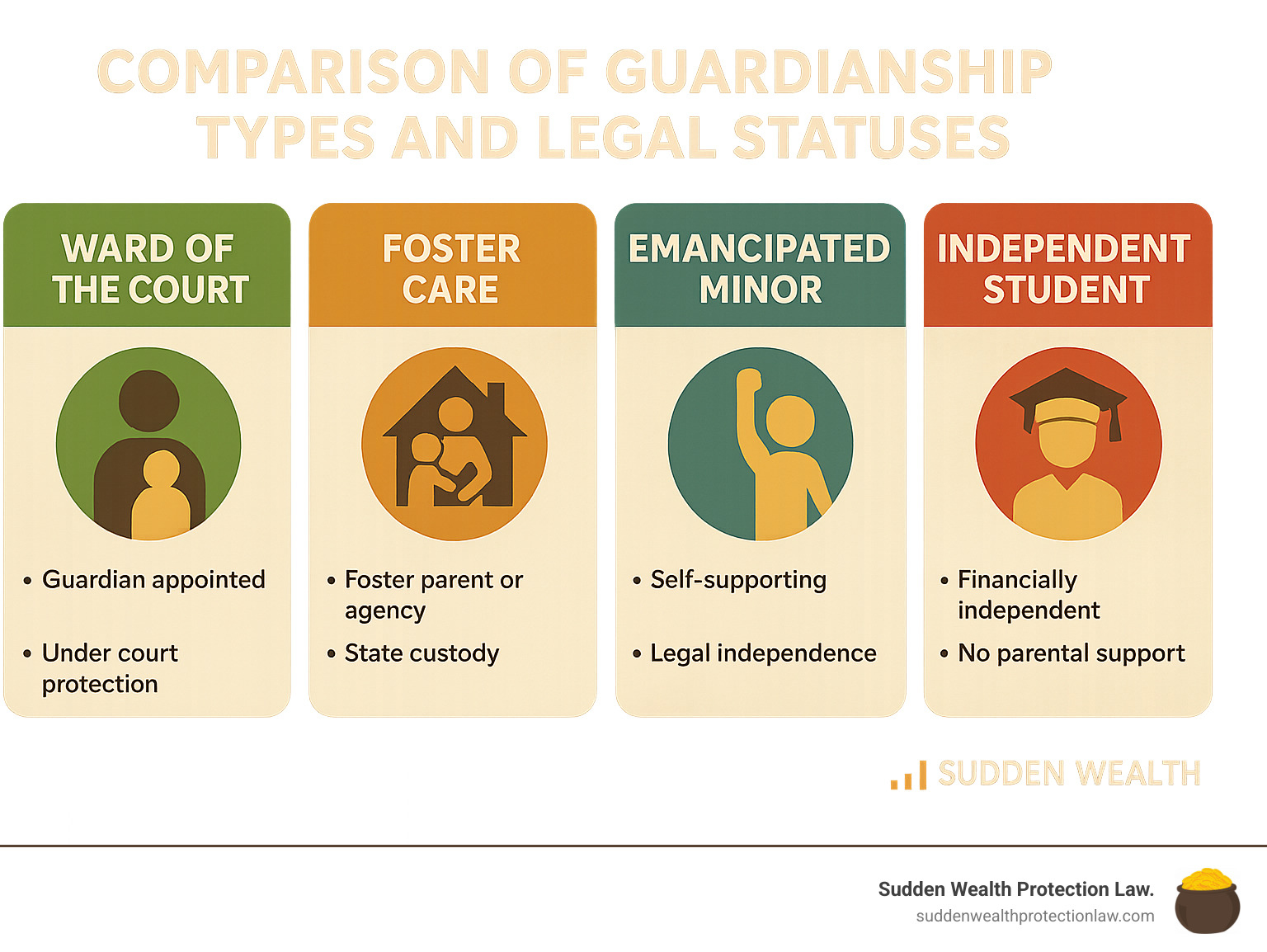
Ward of the Court vs Ward of the State
People often use “ward of the court” and “ward of the state” interchangeably, but there can be important differences depending on where you live and the specific situation.
In some states, a ward of the court specifically means someone under a court-appointed guardian’s protection, while “ward of the state” might refer to someone in foster care or under a government agency’s supervision. In other places, these terms mean basically the same thing.
One common misconception is that people who are incarcerated automatically become wards of the state. This isn’t true. As clarified in FAFSA guidance, being in prison doesn’t create ward status for federal financial aid purposes.
Another important distinction involves Voluntary Placement Agreements, where parents temporarily place children in state care while keeping legal custody. In these situations, the child isn’t technically a ward of the court because the parents still have their parental rights.
As one financial aid administrator put it, “A high percentage of student claims to be a ward of the court are made in error, because the student assumes that having a legal guardian makes them a ward of the court.” True ward status requires court appointment of a guardian and often termination of parental rights.
Who Can Become a Ward of the Court?
Several groups of people can become wards of the court:
Minors under 18 may become wards when they suffer abuse or neglect, their parents have died or become incapacitated, they’ve been abandoned, or they show serious behavioral problems requiring court intervention.
Incapacitated Adults may become wards when they can’t care for themselves due to cognitive disabilities, mental illness, advanced dementia or Alzheimer’s, or severe physical disabilities that affect decision-making.
Other Vulnerable Individuals in some places may receive ward status, including elderly persons at risk of exploitation or people with substance abuse disorders that severely impair judgment.
Here in Arizona, our laws specifically address guardianship for both minors and incapacitated adults, though the procedures and standards differ somewhat between these groups.
It’s interesting to note that in England and Wales, any child physically present or normally living in these jurisdictions can be made a ward, regardless of their citizenship or permanent residence. This shows how broadly courts can use their protective power when a child’s welfare is at stake.
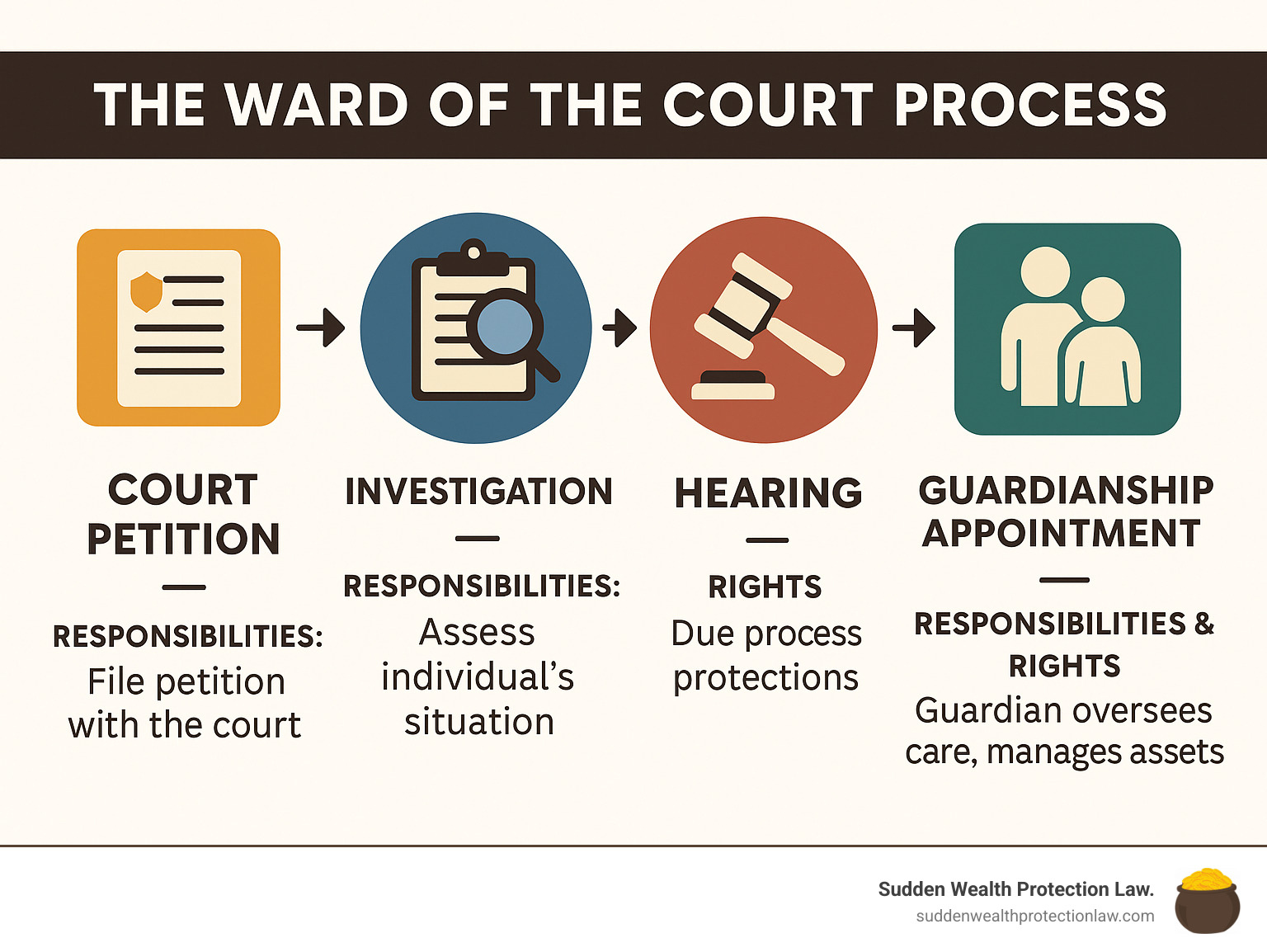
How Someone Becomes a Ward of the Court: Step-by-Step Process

Becoming a ward of the court isn’t something that happens overnight. It’s a thoughtful legal journey with built-in safeguards to protect vulnerable individuals while respecting their rights. Having guided many Arizona families through this process, I’ve seen how understanding each step helps ease anxiety during what can be an emotional time.
Filing the Petition
Everything begins with someone taking that first important step – filing a petition with the court. In Arizona, this typically happens at the probate division of the Superior Court.
The person filing doesn’t have to be a family member, though they often are. Concerned friends, healthcare providers, social workers, or really anyone with a legitimate interest in the person’s welfare can step forward. I once worked with a devoted neighbor who initiated proceedings when she noticed her elderly friend showing serious signs of dementia and self-neglect.
The petition isn’t just paperwork – it’s telling the court a story about why protection is needed. For children, this might include details about abuse or neglect. For adults, medical evidence typically documents their inability to make sound decisions. The petition needs to be specific and compelling, as courts don’t take removing someone’s autonomy lightly.
When situations are dire, courts can move quickly. I’ve seen judges schedule emergency hearings within 24 hours when someone was at immediate risk. As one Arizona court clerk told me, “These cases jump to the front of the line when someone’s safety is on the line.”
For those in the UK system, the specific form for wardship applications is Form C66, accompanied by supporting documentation that outlines the reasons for the application.
The Court Investigation & Evaluation
Once the petition is filed, the court doesn’t simply take the petitioner’s word. Instead, it launches a thorough investigation to verify the claims and determine if court protection is truly necessary.
For adults, this usually involves capacity examinations where medical professionals evaluate the person’s ability to make sound decisions. These evaluations look at whether the person understands their circumstances, can communicate choices, and appreciates consequences.
The court often appoints a Guardian Ad Litem (GAL) – an attorney who acts as the eyes and ears of the court. Unlike other attorneys in the case, the GAL isn’t advocating for what the person says they want, but rather what would be in their best interest. This distinction is crucial in cases where the person’s judgment is compromised.
A court investigator may also interview everyone involved – the potential ward, family members, caregivers – and review medical records to build a complete picture. Meanwhile, the potential ward has the right to their own attorney who will fight for what they want, not just what others think is best for them.
“We need clear and convincing evidence before removing someone’s right to make their own decisions,” explained an Arizona probate judge during a case I handled. This higher standard of proof reflects how seriously courts take these proceedings.
Medical documentation carries significant weight. Typically, at least one physician must certify that the individual lacks capacity to make or communicate responsible decisions about their care or finances.
The Hearing and Order
The courtroom is where all evidence comes together. During this formal hearing, the petitioner presents their case, witnesses testify, and experts may offer opinions about the potential ward’s capacity.
The person at the center of the case has the right to attend and contest everything. I always encourage my clients to respect this right, even when they believe their loved one lacks understanding of the proceedings. Courts notice when families honor the dignity of the potential ward.
Family dynamics often surface during these hearings. I’ve witnessed adult children disagree about a parent’s capacity, each bringing different observations to the court’s attention. These perspectives help judges make informed decisions.
If the evidence convinces the court that guardianship is necessary, it will issue an order making the individual a ward of the court and appoint a guardian. For minors, this sometimes includes terminating parental rights, though that’s not always required or appropriate.
The final step is issuing “Letters of Guardianship” – the official document that empowers the guardian to act. These letters serve as proof of authority when dealing with doctors, schools, government agencies, and other institutions.
“The process seemed intimidating at first,” shared one client after we secured guardianship for her mother with advancing dementia, “but having someone guide us through each step made it manageable. Now I have the legal authority to ensure Mom gets the care she needs.”
The entire process typically takes several weeks to months, depending on the complexity of the case and how busy the court docket is. Emergency situations can move much faster when necessary.
For more detailed information about navigating guardianship proceedings in Arizona, visit our Guardianships and Conservatorships page.
Rights, Responsibilities & Financial Implications
When someone becomes a ward of the court, their life changes significantly. This legal status shifts decision-making authority to others while creating a web of responsibilities designed to protect vulnerable individuals. Understanding these changes helps everyone steer this complex arrangement with clarity and compassion.
Rights Retained and Lost by the Ward
Being designated a ward of the court means surrendering certain freedoms while maintaining others. It’s a delicate balance that courts try to manage thoughtfully.
Wards typically lose their ability to make independent medical decisions, choose their living situation, and manage their finances. Many can no longer enter into legal contracts. In some cases, even the fundamental right to vote may be restricted, though this varies by jurisdiction and the specific guardianship order.
Despite these limitations, wards retain essential human dignities. They have the right to appropriate care and respectful treatment. They can petition the court if they believe their capacity has improved. They maintain the right to request a different guardian if problems arise. Perhaps most importantly, they keep their right to personal relationships and social connections.
As one Arizona judge told me during a particularly sensitive case, “Our goal is never to strip people of their humanity—just to protect them from harm they cannot recognize or prevent themselves.”
The Arizona Supreme Court has consistently emphasized that guardianship should promote wellbeing while encouraging “growth, independence and self-reliance to the maximum extent possible.” This philosophy guides courts toward limited guardianships when appropriate, which restrict only specific rights rather than transferring all decision-making authority.
Guardian’s Powers and Duties
Taking on guardianship means accepting profound responsibilities. Guardians become the voice and advocate for someone who can no longer fully speak for themselves.
Healthcare decisions often top the list of guardian duties. From routine check-ups to major medical interventions, guardians must make choices that serve the ward’s best interests. They select healthcare providers, authorize treatments, and ensure appropriate ongoing care.
Living arrangements fall squarely within the guardian’s authority. Whether the ward lives at home with support services, with family members, or in a residential facility depends on the guardian’s assessment of safety, needs, and available resources.
For minors, guardians take on the additional role of educational decision-maker. They enroll children in school, attend parent-teacher conferences, and authorize participation in extracurricular activities.
The court doesn’t simply hand over this authority without oversight. Guardians must regularly report back about the ward’s condition, living situation, and services received. In Arizona, this means filing an initial inventory of the ward’s assets (if under $10,000) and submitting annual reports detailing the ward’s well-being.
“I always try to involve my sister in decisions about her care, even though I have legal authority,” one guardian shared with me. “It’s about preserving her dignity and respecting her as a person, not just checking boxes on legal requirements.”
This sentiment reflects best practice—guardians should consider the ward’s wishes whenever possible, even when they have full legal authority to make unilateral decisions.
Who Pays? Finances & State Support
The financial aspects of wardship often create confusion and concern. Who bears responsibility for a ward’s expenses? The answer varies depending on circumstances.
When a ward has assets, these resources typically fund their care first. For wards with substantial holdings, the court usually appoints a conservator to manage finances. Sometimes the guardian and conservator are the same person, but they can be different individuals with separate responsibilities.
Many wards qualify for government assistance programs. Medicaid often covers healthcare costs for those with limited resources. Medicare may apply for elderly wards. Supplemental Security Income (SSI) or Social Security Disability Insurance (SSDI) can provide monthly income for basic needs.
Guardians themselves may receive reasonable compensation from the ward’s estate, though family members frequently serve without payment out of love and dedication. When wards have minimal financial resources, state agencies sometimes step in to provide essential support.
For college-bound students, ward of the court status carries significant financial aid implications. Under FAFSA rules, students who were in foster care or made a ward of the court at any time since age 13 are considered independent students. This classification often results in more generous financial aid packages since parental income isn’t considered in the calculation.
“Documentation is crucial for students claiming ward status,” explained a financial aid officer I consulted. “We typically require a copy of the court order or a clarifying letter from a judge to confirm eligibility.”
The financial implications of wardship extend beyond immediate care needs. Proper planning helps ensure long-term security and prevents exploitation. For more information about protecting vulnerable adults from financial exploitation, visit our page on Financial Exploitation of Vulnerable Adults.
Terminating or Challenging Wardship

Being a ward of the court isn’t necessarily a life sentence. In fact, there are several pathways to ending or modifying this legal status when circumstances change. I’ve guided many families through this process, and it’s often a moment of celebration when appropriate wardship arrangements evolve or end.
How Wardship Ends Automatically
Some wardship situations resolve themselves naturally without requiring additional court intervention. The most common automatic termination happens when a minor turns 18. I remember one client’s son who had been under court protection since age 12 – the family actually threw a “guardianship graduation party” when he reached majority age!
Adoption is another natural endpoint for minor wardships. When loving adoptive parents step in and assume full parental rights, the court’s protective role becomes unnecessary. The creation of a care order in certain jurisdictions can also trigger the end of wardship status.
And of course, wardship naturally concludes upon the ward’s death, though this is obviously the least happy resolution.
The story of football player Michael Oher (whose life inspired “The Blind Side”) offers an interesting example. After petitioning the Tennessee courts, his long-standing conservatorship was terminated by court order, showing that even established arrangements can change when circumstances warrant review.
Petitioning to Terminate or Modify
When automatic termination doesn’t apply, interested parties need to take proactive steps through the court system. For adult wards who have regained capacity, this typically involves gathering medical evidence showing improved decision-making ability. I’ve helped several clients with cognitive impairments petition successfully after rehabilitation or treatment improved their condition.
Guardian misconduct unfortunately happens sometimes. When a guardian fails to fulfill their duties or abuses their position, family members or other concerned parties can petition for their removal and replacement. One particularly satisfying case involved helping a niece become guardian after uncovering her uncle’s financial exploitation of her elderly aunt.
Changed circumstances often justify modifying guardianship arrangements. Perhaps a less restrictive arrangement becomes appropriate, or maybe the ward’s condition has significantly improved. As one Arizona probate attorney I regularly work with notes, “The burden of proof for terminating guardianship typically falls on the petitioner, who must show clear and convincing evidence that termination serves the ward’s best interests.”
Oversight & Accountability Mechanisms
Courts don’t just establish wardships and walk away – they maintain ongoing supervision to protect vulnerable individuals. Annual reviews form the backbone of this oversight, with guardians required to file reports detailing the ward’s condition, living situation, and care received. These reports aren’t just paperwork – judges and court staff actually review them for red flags.
Financial accountability matters tremendously. When guardians manage a ward’s assets, courts often require detailed financial accountings to prevent misuse of funds. One client described the process as “like having your personal checkbook audited every year” – which is exactly the point!
Court investigators serve as the eyes and ears of the judge, verifying information in reports or investigating complaints from family members or the ward. These investigators often make unannounced visits to ensure the ward’s living conditions match what’s been reported.
Guardians who fail to meet their obligations face serious consequences. I’ve seen courts remove guardians, impose fines, and in severe cases of exploitation, refer cases for criminal prosecution. The system isn’t perfect, but these accountability mechanisms provide essential protections.
The high-profile case of Britney Spears demonstrated how public scrutiny and advocacy can challenge arrangements that no longer serve their intended purpose. While most wardship situations don’t attract celebrity attention, the principle remains the same – these arrangements should evolve or end when they no longer benefit the protected person.
For students claiming ward status for financial aid purposes, documentation proves critical. Financial aid administrators typically request a letter from a judge clarifying the student’s status under Section 480(d)(2) of the Higher Education Act to ensure benefits go to those who truly qualify.
Alternatives to Wardship & Planning Ahead
When it comes to protecting loved ones, full guardianship and becoming a ward of the court isn’t always the best answer. There are gentler approaches that provide protection while allowing people to maintain more of their independence and dignity.

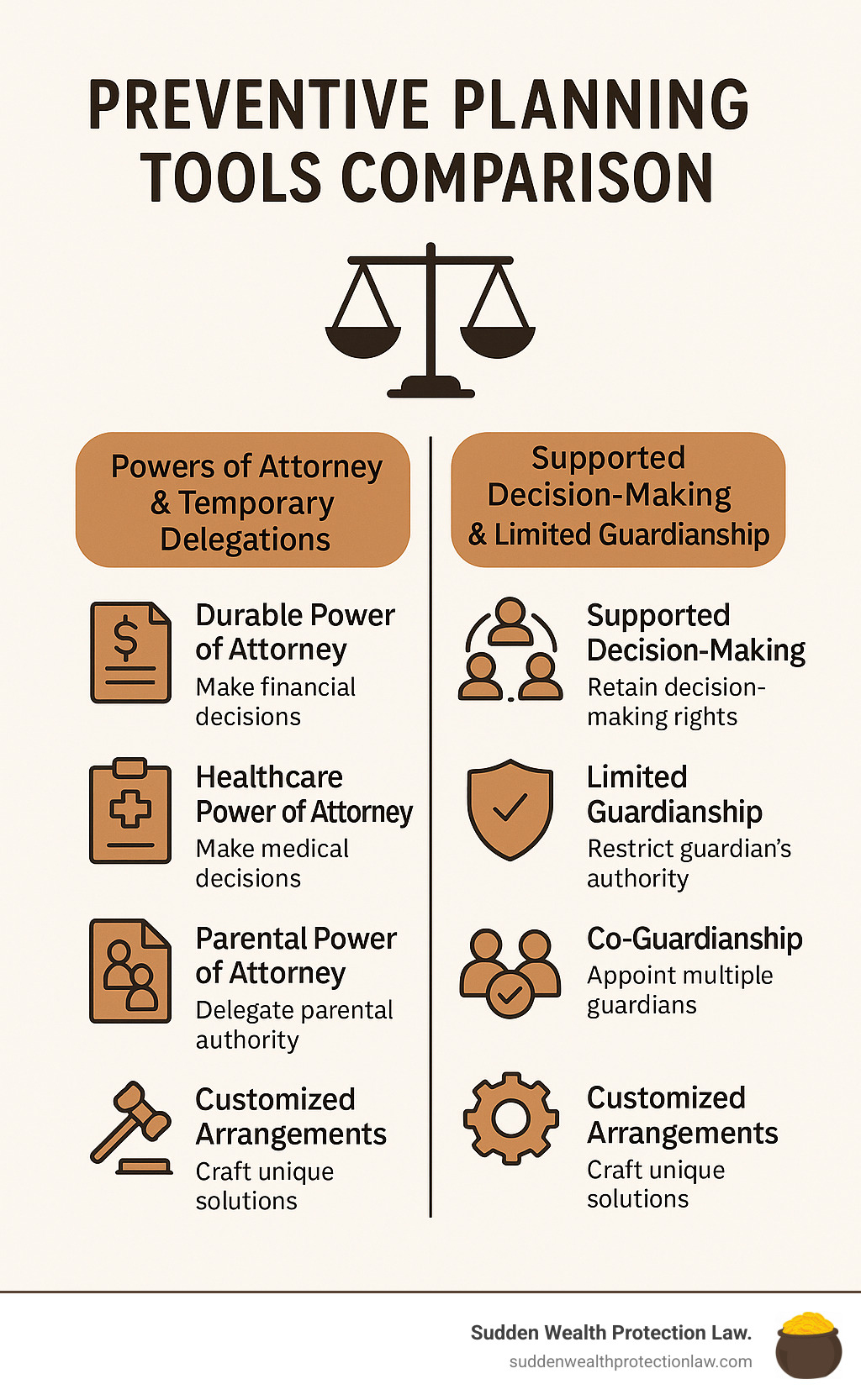
Powers of Attorney & Temporary Delegations
Sometimes life throws temporary challenges our way that don’t require permanent solutions. For these situations, several legal tools can help:
A Durable Power of Attorney lets you appoint someone to handle financial matters if you become unable to do so, while a Healthcare Power of Attorney designates someone to make medical decisions on your behalf.
For parents facing temporary challenges, Arizona offers a practical solution. Under statutes §§14-5104 and 14-5107, parents can temporarily delegate their authority to another trusted adult for up to six months. Military families get extended coverage—up to a year—recognizing the unique demands of service.
“When I needed unexpected surgery last year,” recalls Sarah, a Phoenix mom, “I used a Parental Power of Attorney so my sister could handle school pickups and doctor visits for my kids. It was straightforward and kept us from having to involve the courts during an already stressful time.”
These documents must be created while a person still has the capacity to understand what they’re signing. The beauty of these arrangements is that they can be customized to delegate only specific powers and can be revoked if circumstances change.
Supported Decision-Making & Limited Guardianship
Between complete independence and full guardianship lies a spectrum of options that can be custom to individual needs:
Supported Decision-Making preserves a person’s autonomy while providing a framework of trusted advisors who can help them understand choices and consequences. The individual maintains final decision-making authority, but benefits from guidance along the way.
When some legal authority is needed, Limited Guardianship can restrict a guardian’s powers to specific areas of concern—like medical decisions—while allowing the person to maintain control over other aspects of their life, such as where they live or how they spend their social time.
In more complex situations, Co-Guardianship appoints multiple guardians who must work together, creating a natural system of checks and balances that protects the ward’s interests.
Judge Martinez, who presides over guardianship cases in Maricopa County, puts it perfectly: “The court’s goal is always to find the least restrictive arrangement that provides necessary protection. Each person deserves to maintain as much of their independence as possible.”
The best time to consider these alternatives is before a crisis occurs. Thoughtful planning can prevent the need for court intervention and preserve both dignity and family harmony.
For more comprehensive information about our estate planning services that can help you avoid court intervention, visit our Estate Planning page. We’re here to help you find the right balance of protection and independence for your unique situation.
Frequently Asked Questions about Becoming a Ward of the Court
Navigating the complexities of ward of the court status can be confusing. Here are answers to some of the most common questions we receive from clients and students concerned about their legal status.
Does guardianship automatically make someone a ward of the court?
This is perhaps the most common misconception I encounter in my practice. Having a legal guardian does not automatically make someone a ward of the court.
Many guardianships are established through private arrangements like power of attorney documents without any court involvement whatsoever. True ward of the court status specifically requires a court to appoint a guardian through formal proceedings, and often involves termination of parental rights in cases involving minors.
I recently helped a grandmother who was confused about this very issue. She had been caring for her grandson for years under a private family arrangement, but mistakenly believed this made him a ward of the court for financial aid purposes. We had to explain that without court appointment, he didn’t qualify for independent student status.
In Arizona, this distinction carries significant practical implications. Court-appointed guardianships involve ongoing judicial supervision, annual reporting requirements, and potential court audits. Private arrangements typically operate without this oversight, giving families more flexibility but also less formal protection.
Can incarceration or emancipation qualify me as a ward for FAFSA purposes?
I’ve seen many students make this mistake on financial aid applications. According to federal financial aid guidelines, being incarcerated does not make someone a ward of the court for FAFSA purposes.
Similarly, being legally emancipated under state law doesn’t automatically qualify a student as independent under federal financial aid rules. These are separate legal statuses with different implications.
As one of my clients finded after consulting with a financial aid officer: “The FAFSA has very specific definitions for dependency status. Just because I was on my own at 17 didn’t mean I qualified as independent under their rules.”
It’s critically important to understand these distinctions before completing financial aid applications. Claiming ward of the court status incorrectly can lead to verification problems, delayed financial aid, or even accusations of fraud in serious cases.
What documents prove my ward status to a university or lender?
When you need to verify ward of the court status for financial aid or other purposes, having the right documentation is essential. Based on my experience helping clients steer this process, you’ll typically need:
Court Order – The foundation of your claim should be the actual court decree or order that declared your ward status. In some jurisdictions, this might be called a “Form 10-24 Order of Disposition” or something similar.
Judge’s Letter – Sometimes court orders use legal language that doesn’t clearly address financial aid regulations. In these cases, request a clarifying letter from the judge confirming your status specifically under Section 480(d)(2) of the Higher Education Act.
State Documentation – For those who were in foster care, documentation from the state agency responsible for your care can serve as proof of your status.
One former ward I worked with shared: “The financial aid office kept rejecting my documentation until I got a specific letter from the judge stating I was a ward of the court under federal financial aid guidelines. That finally resolved everything.”
Financial aid administrators do have the authority to perform a dependency override in exceptional circumstances, even if you don’t technically qualify as a ward of the court. This discretionary authority can be valuable in cases where your situation doesn’t fit neatly into the standard categories.
If you’re struggling with questions about ward of the court status or need help securing proper documentation, our team at Sudden Wealth Protection Law can provide guidance. We understand how important these determinations can be for educational funding and other benefits.
Conclusion
Becoming a ward of the court represents a significant turning point in someone’s life—a moment when the legal system steps in to provide protection for those who cannot protect themselves. While this arrangement creates a vital safety net, it also comes with considerable limitations on personal freedom and introduces ongoing court supervision.
The journey to wardship isn’t taken lightly. It involves thoughtful consideration, detailed investigations, and formal legal proceedings to ensure this protective measure truly serves the vulnerable person’s best interests. Throughout this process, courts work diligently to strike that delicate balance between providing necessary protection while preserving as many personal rights as possible.
Many families find that with proper planning, court intervention can often be avoided entirely. At Sudden Wealth Protection Law, we specialize in helping Arizona families develop comprehensive estate plans that include powerful protective tools like durable powers of attorney, Asset Vault Trusts, and other mechanisms that safeguard vulnerable family members while maintaining their dignity and independence.
I’ve seen how the right planning can make all the difference. One client shared, “We were worried about our son with special needs, but creating a Special Needs Trust gave us peace of mind knowing he’ll be protected without becoming a ward of the court.”
Whether you’re concerned about a loved one who may need protection now, or you’re wisely planning ahead to prevent court intervention in the future, understanding the ward of the court process is an essential first step. Our compassionate team is ready to provide guidance custom specifically to your family’s unique circumstances and needs.
Proactive planning isn’t just about legal documents—it’s about creating security and peace of mind for those you love most. The right planning tools can help ensure your loved ones receive the protection they need while maintaining their autonomy and dignity.
For more information about estate planning options that can help prevent the need for court wardship, visit our Estate Planning page or contact us to schedule a consultation. Together, we can create a plan that protects what matters most to you.

