

Safeguarding Your Legacy: The Role of a Trust Protector
A trust protector is a third party appointed in a trust document who has specific powers to oversee trustees and make changes to an irrevocable trust without court intervention. Think of them as a safeguard for your long-term estate plan.
| What is a Trust Protector? | Common Powers | When They’re Needed |
|---|---|---|
| An independent third party with oversight authority over a trust | – Remove/replace trustees – Amend trust terms – Change trust location – Add/remove beneficiaries – Approve distributions |
– Long-term/dynasty trusts – Complex asset situations – When flexibility is needed – Special needs trusts – Asset protection planning |
Trust protectors originated in offshore asset protection trusts but have become increasingly common in domestic estate planning. They serve as the eyes, ears, and voice of the trust creator after they can no longer act themselves.
Unlike trustees who handle day-to-day trust administration, trust protectors step in only when necessary to ensure the trust continues to fulfill its intended purpose despite changes in law, family circumstances, or other unforeseen events.
The concept addresses a fundamental problem in estate planning: how do you create an irrevocable trust that can still adapt to future changes you can’t predict?
I’m Paul E. Deloughery, founder of Sudden Wealth Protection Law, and I’ve helped hundreds of clients incorporate trust protectors into their estate plans to provide flexibility and protection that standard irrevocable trusts simply can’t offer.
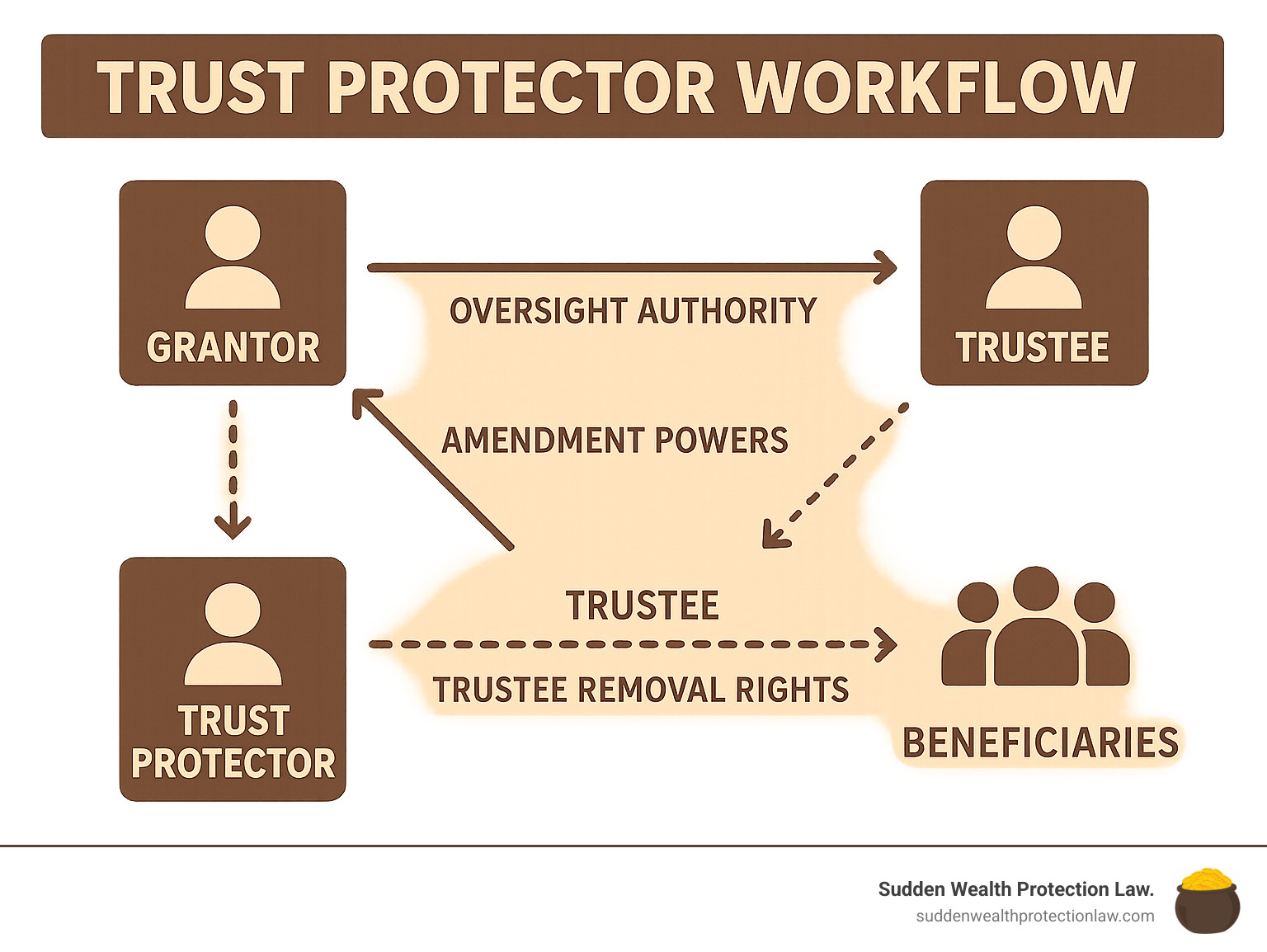
Know your trust protector terms:
What Is a Trust Protector?
Think of a trust protector as the guardian angel of your estate plan. When you create a trust—especially an irrevocable one—you’re making decisions today that might need to stand the test of time for decades. But tax laws change, family dynamics shift, and the world evolves in ways none of us can predict.
That’s where a trust protector steps in. They’re not the trustee managing your assets day-to-day, nor are they a beneficiary. Instead, they serve as a third party with specific powers to oversee your trust and make certain adjustments without the headache and expense of going to court.
Here in Arizona, our law (A.R.S. §14-10818) formally recognizes the trust protector as a “trust director” who can exercise specific powers over a trust’s administration. This provision is part of Arizona’s adoption of elements from the Uniform Directed Trust Act.
I’ve seen the concept become particularly crucial for dynasty trusts designed to benefit multiple generations. As I often tell clients, “Writing rules today that will make perfect sense for your great-grandchildren is like trying to predict what smartphones will look like in 50 years.”
Trust Protector vs. Trustee vs. Advisor
These roles serve distinctly different functions in your estate plan:
| Role | Primary Function | Authority | Liability Standard |
|---|---|---|---|
| Trust Protector | Oversight and modification | Powers specifically granted in trust document | Varies by state and trust terms |
| Trustee | Day-to-day administration | Management of assets, distributions | Fiduciary duty, prudent investor rule |
| Trust Advisor | Specialized guidance | Advisory only, unless granted specific powers | Usually limited to area of expertise |
If your trust is a ship, the trustee is the captain handling daily operations. The trust protector is more like the admiral who typically stays on shore but has the authority to step in for major course corrections or even replace the captain if needed.
Some clients ask about simply appointing a co-trustee instead of a trust protector. While this can work in certain situations, it often creates unnecessary friction. Co-trustees must agree on all decisions, which can lead to deadlock. A trust protector only steps in when specific circumstances warrant intervention.
For more information about the trustee’s role, visit our guide on trust administration for dummies.
Trust Protector Fiduciary Status
One of the most debated questions in trust law is whether a trust protector serves as a fiduciary. The answer depends on how your trust is drafted.
Under the Uniform Trust Code §808, which has been adopted in some form by more than 30 states, there’s a rebuttable presumption that third-party power holders (including trust protectors) are fiduciaries. This means they’re generally expected to act in the best interests of the beneficiaries.
However, your trust document can expressly state otherwise. We can draft provisions that clearly specify your trust protector is not acting as a fiduciary, or perhaps that they’re only a fiduciary when exercising certain powers but not others.
In Arizona specifically, our laws follow the Uniform Directed Trust Act approach, treating trust directors (including trust protectors) as having fiduciary duties similar to trustees, unless your trust document explicitly says otherwise.
This distinction has real consequences. A fiduciary trust protector can potentially be held liable for decisions that harm the trust or its beneficiaries. A non-fiduciary trust protector generally can only be held liable for actions taken in bad faith or with gross negligence—a much higher threshold.
History & Evolution of the Role
The concept of trust protectors has a fascinating evolutionary path. While the idea of entrusting property to others dates back to the 12th century Crusaders, the modern trust protector role has much more recent origins.
I often tell clients that trust protectors were born out of necessity and a healthy dose of skepticism. Back in the 1980s, wealthy Americans began establishing offshore asset protection trusts in places like the Cook Islands and Nevis. But there was an obvious concern: how comfortable would you feel having foreign trustees controlling your assets with no oversight?
The solution was to appoint someone trustworthy back home as a trust protector with the power to fire that foreign trustee if they started acting suspiciously. It was essentially a fail-safe mechanism that gave people the confidence to use offshore structures.
This practical innovation proved so useful that it gradually migrated into domestic trust planning. South Dakota recognized the brilliance of the concept and became the first state to enact a trust protector statute in 1997. Arizona wasn’t far behind, adding trust protector provisions to our state trust code in 2002.
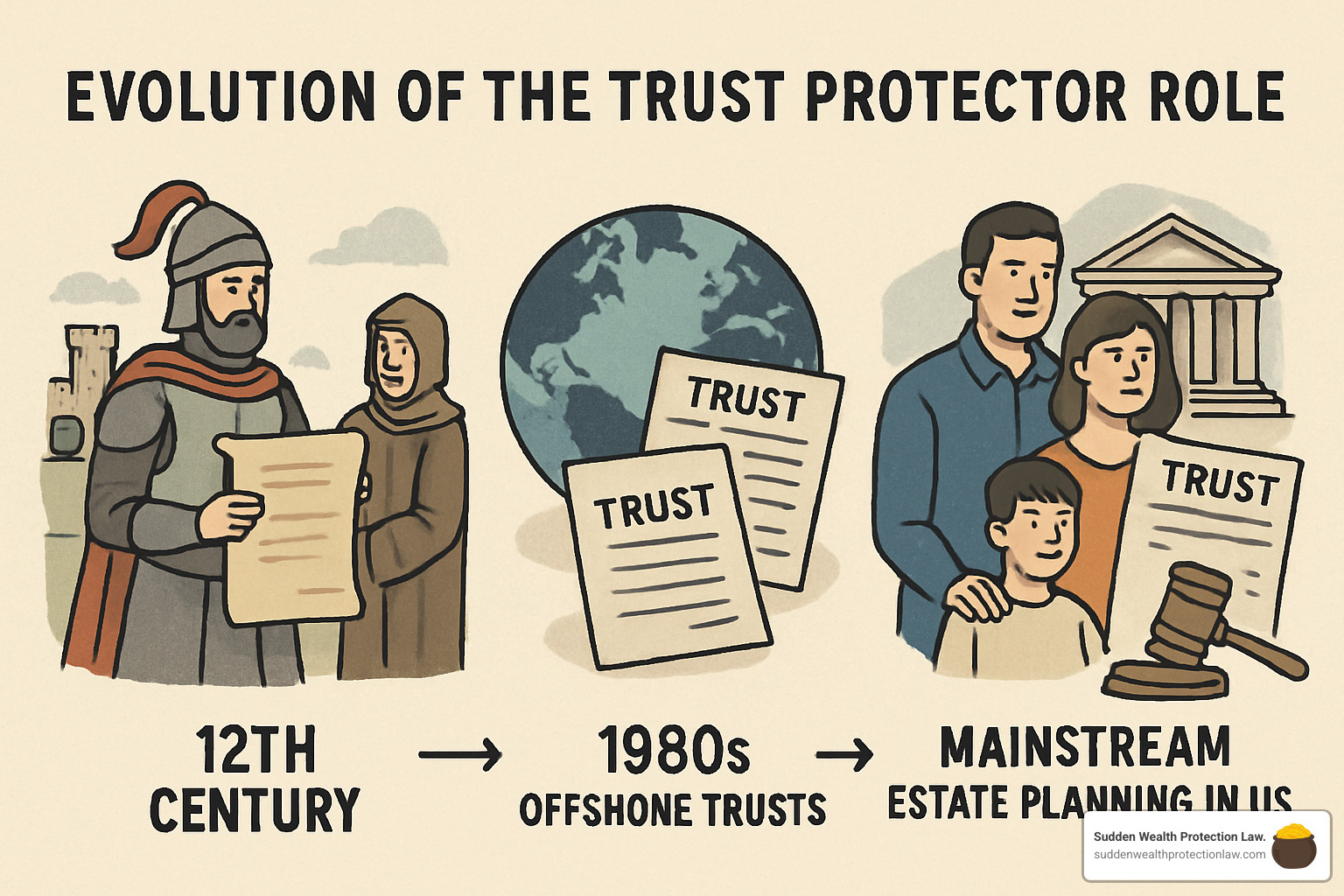
The adoption of trust protector provisions has been remarkably swift in historical terms. Today, only three U.S. states don’t have statutes addressing trust protectors or directed trusts in some form. The Uniform Law Commission gave the concept another boost with their 2017 Uniform Directed Trust Act, which has been enacted by 16 states as of 2022.
In my practice at Sudden Wealth Protection Law, I’ve seen how trust protectors have transformed from exotic legal devices to essential components of sophisticated estate plans. They’re particularly valuable in our Asset Vault Trusts, where flexibility and protection must be carefully balanced.
For those interested in deeper research on this topic, the paper “Considerations when acting as a Protector” offers valuable insights into the practical applications and responsibilities of this role.
Core Powers and Authorities
When you add a trust protector to your estate plan, they only have the specific powers you grant them in the trust document. Think of it like handing someone a custom toolbox – they can only use the tools you’ve placed inside.
The most common power – and often the most valuable – is the ability to remove and replace trustees. This is like having an emergency brake if your trustee starts charging excessive fees or isn’t managing assets properly.
Amending trust terms is another crucial power that can save families from expensive court proceedings. This might involve administrative tweaks or more substantial changes to adapt to new tax laws or family situations.
The ability to change trust situs (legal location) gives your trust mobility. Arizona has favorable trust laws, but what if another state develops even better protections in the future? Your trust protector can relocate the trust without starting from scratch.
For growing families, the power to add or remove beneficiaries provides incredible flexibility. When my client’s daughter had twins – the first great-grandchildren – their trust protector was able to include these new family members without court intervention.
Decanting powers allow your trust protector to pour assets from your existing trust into a new, improved trust – like upgrading from an old car to a newer model with better features.
Some trusts include veto powers over trustee decisions, giving the protector oversight on distributions or investments. This creates a healthy checks-and-balances system within your trust structure.
Finally, a special power of appointment lets your protector redirect assets in specific ways outlined in your trust document, providing another layer of flexibility.
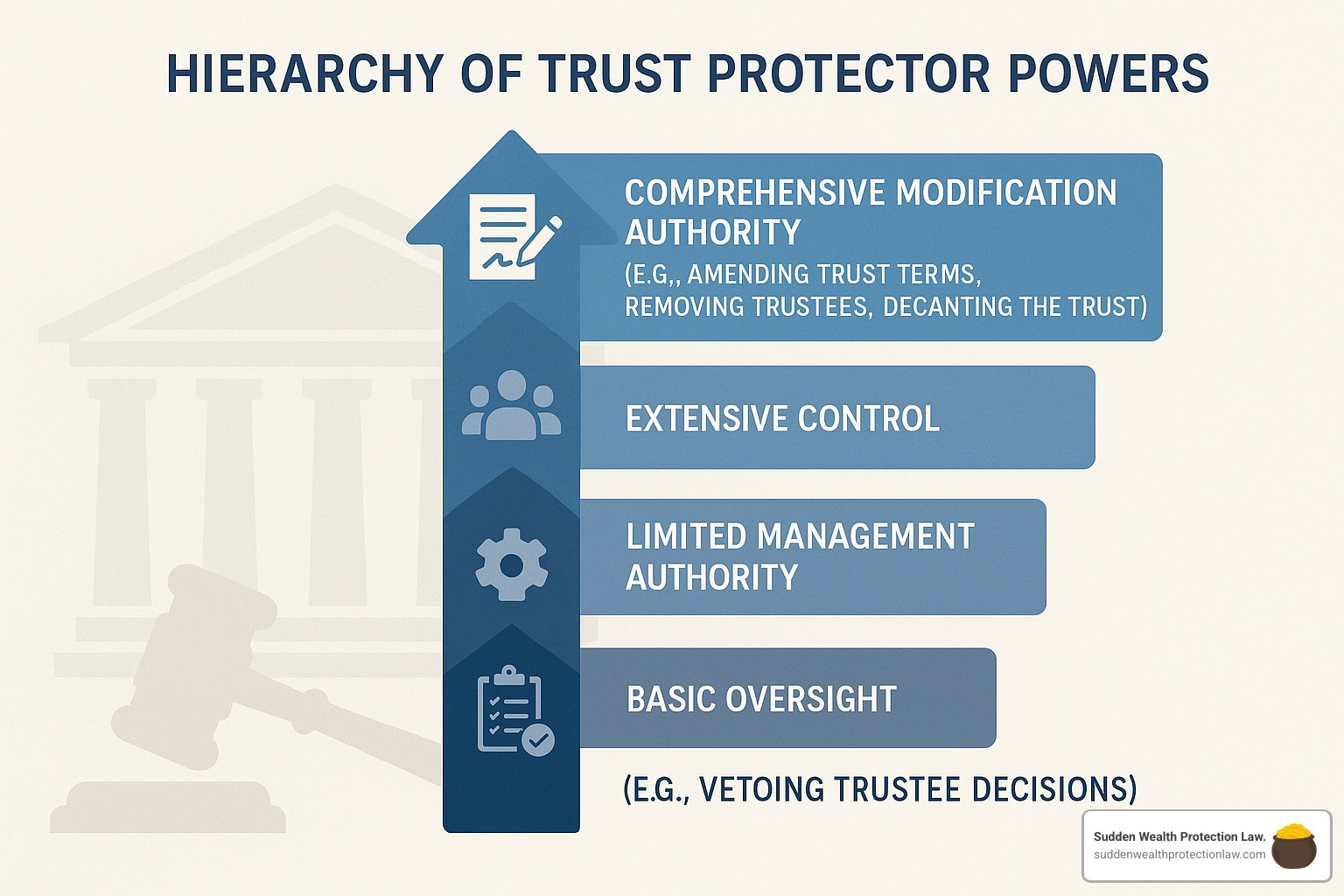
Trust Protector Powers in Arizona
Here in Arizona, our trust law (specifically A.R.S. §14-10818) accepts the concept of directed trusts, which includes the role of trust protectors. The beauty of Arizona’s approach is that it doesn’t restrict what powers you can grant to your protector – giving you tremendous flexibility in designing your trust.
When I create an Asset Vault Trust for clients, I carefully customize the trust protector provisions to balance flexibility with robust asset protection. The Asset Vault Trust incorporates a special power of appointment that, when paired with thoughtfully crafted trust protector provisions, creates what I like to call “adaptive irrevocability.”
This means your trust remains technically irrevocable (crucial for asset protection) while still having the ability to evolve through your trust protector as circumstances change. It’s like having a house with a permanent foundation but modifiable rooms.
Trust Protector Removal and Replacement
Even the most trusted trust protector might need replacement someday. A well-drafted trust should clearly address four key questions:
- What events trigger removal? (Death, incapacity, resignation, or specific grounds)
- Who can remove the protector? (Remaining protectors, beneficiaries, trustees, or a court)
- How are successors chosen? (Named in advance, appointed by beneficiaries, or court-appointed)
- Are there “springing protector” provisions? (Allowing appointment only when needed)
One important tip: I generally recommend against giving the grantor (you) the power to remove and replace the trust protector in irrevocable trusts. This could be seen as retained control that undermines your trust’s asset protection features – exactly what we’re trying to avoid with an Asset Vault Trust.
Benefits, Risks, and Drafting Best Practices
Adding a trust protector to your estate plan is like installing both an airbag and a GPS in your car – they provide safety and the ability to steer changing conditions.
The benefits are substantial. First, flexibility becomes your greatest ally. Your trust can adapt to new tax laws, family dynamics, or unforeseen circumstances without court intervention. This leads directly to significant cost savings – avoiding court modifications typically saves my clients around $10,000 in legal fees.
Privacy is another major advantage. While court proceedings lay your family’s financial matters open for public viewing, a trust protector can make necessary changes behind closed doors.
The expertise a professional trust protector brings to the table can be invaluable when laws change or complex tax situations arise.
I’ve also seen trust protectors effectively resolve family conflicts that might otherwise have torn families apart. They serve as neutral third parties who can mediate disputes between beneficiaries and trustees.
But there are risks to consider as well:
- Potential conflicts of interest can arise if your protector has close personal ties to certain beneficiaries
- Granting overbroad powers could undermine your intentions
- Tax complications lurk in the background of many trust protector provisions
- Liability concerns often arise when the protector’s fiduciary status isn’t clearly defined
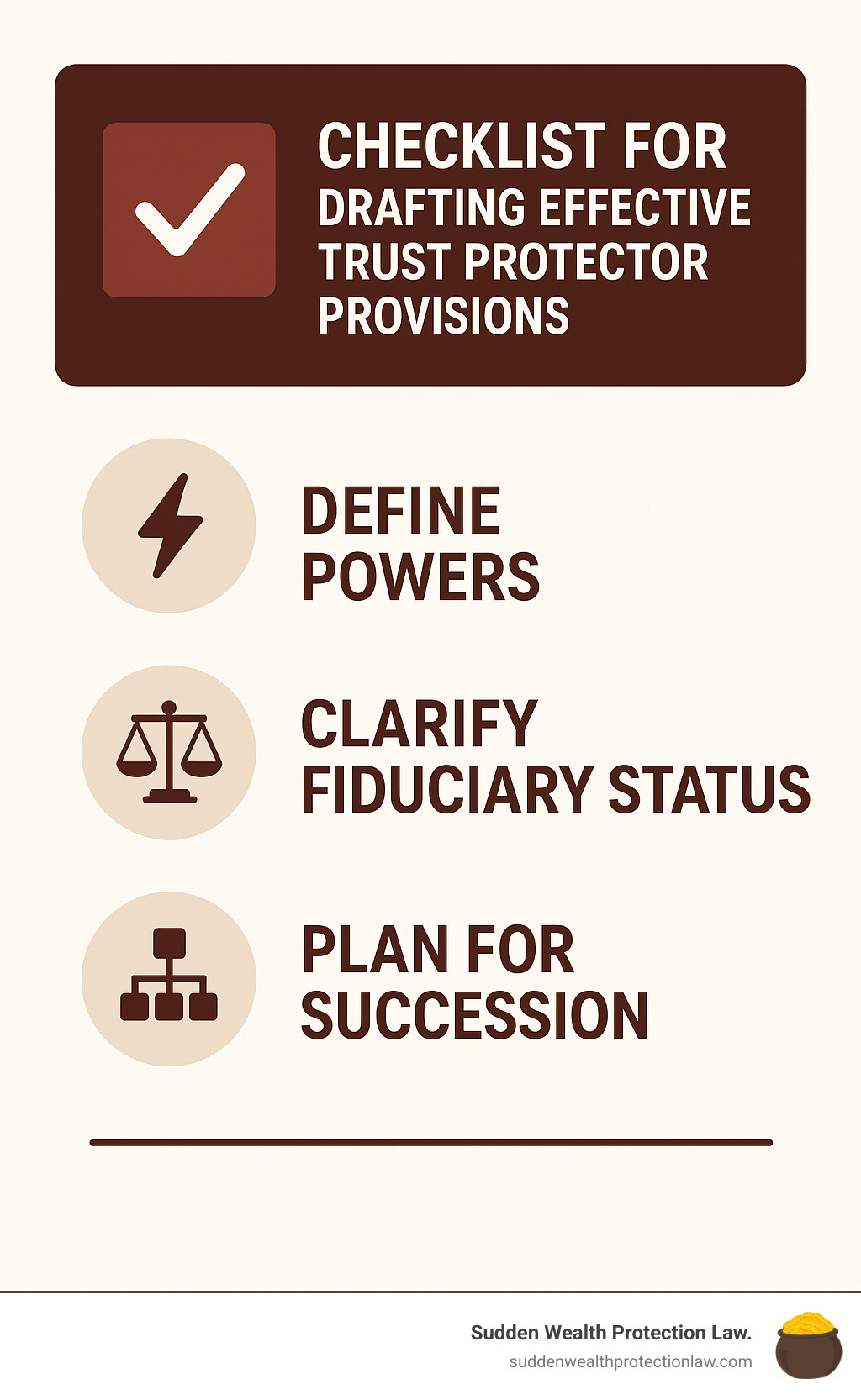
Drafting Best Practices for Trust Protectors
After decades crafting trust protector provisions, I’ve developed some hard-earned wisdom about what works:
-
Clearly defined powers: Vague language like “the protector may modify the trust as needed” is a lawsuit waiting to happen. Be specific about what actions the protector can take and under what circumstances.
-
Explicitly address fiduciary status: The trust should state whether the protector is acting as a fiduciary for each power granted.
-
Information access: Include provisions ensuring they receive trust accountings, tax returns, and other relevant documents.
-
Liability protection: Reasonable exculpatory clauses and indemnification provisions make the role more appealing to professionals.
-
Clear standards: Rather than simply stating the protector can remove trustees, specify the grounds – such as excessive fees or poor investment performance.
-
Succession plan: I’ve seen too many trusts where the named protector died or became incapacitated with no replacement mechanism.
-
Reasonable compensation: Acknowledge that serving as a trust protector requires time, expertise, and assumption of risk.
-
Document your intent: A brief explanation of why you’re granting certain powers can be invaluable if questions arise later.
State-Law Variations & Tax Traps
Trust law varies significantly across states, creating both opportunities and pitfalls.
The Uniform Directed Trust Act (UDTA) has brought some consistency to this area. As of 2022, 16 states have adopted this comprehensive framework for trust protectors. Arizona has incorporated elements of the UDTA approach into its trust code.
Fiduciary presumptions vary widely. States that have adopted UTC §808 generally presume trust protectors are fiduciaries unless the trust document says otherwise. Arizona leaves this determination primarily to the trust document, offering more drafting flexibility.
Tax considerations are some of the most dangerous traps. Powers that benefit the protector personally could cause inclusion in their taxable estate. Certain powers might trigger gift tax consequences if not carefully drafted.
The location (situs) of your trust affects state income taxation. A trust protector with the power to change situs creates valuable situs shopping opportunities.
In Arizona, we benefit from favorable trust laws that provide significant flexibility for trust protectors while maintaining strong asset protection features. This makes our Asset Vault Trust particularly well-suited for long-term wealth preservation strategies.
For more information about how Arizona’s trust laws can protect your assets, visit our Arizona Trust Asset Protection page.
Special Applications & Case Law
Trust protectors have found their sweet spot in several specialized areas of estate planning, where their flexibility and oversight powers truly shine.
Special Needs Trusts
For families with disabled loved ones, a trust protector can be worth their weight in gold. Government benefit programs like Medicaid and SSI have complex rulebooks that change constantly.
I remember helping a client whose daughter relied on SSI benefits. When the Social Security Administration suddenly changed their policy on travel reimbursements, we faced a crisis. Thankfully, the trust protector amended the trust within days—no court appearance, no public hearing, no $10,000 legal bill.
Asset Protection Planning
In our Asset Vault Trust (what some call a “541 Trust”), the trust protector plays a crucial role in maintaining both flexibility and protection. Our approach uses carefully crafted trust protector provisions alongside a special power of appointment to create a structure that’s both resilient and adaptable.
I often tell clients: “Your Asset Vault Trust is like a fortress with secret passages only the right people know about.” The trust protector holds the keys to those passages, allowing necessary changes while keeping the walls strong against creditors.
Dynasty Trusts
For trusts designed to benefit multiple generations, a trust protector isn’t just helpful—it’s practically essential. I ask clients: “Can you predict what your great-grandchildren will need? What tax laws will exist in 80 years?” Of course not. But a properly empowered trust protector can ensure the trust remains relevant and effective as times change.
Notable Case Law
While trust protector case law is still developing, several important cases provide valuable guidance:
Minassian v. Rachins (Florida, 2014) became a landmark case when the court upheld a trust protector’s authority to amend a trust to resolve ambiguities. The court recognized the protector’s role in carrying out what the trust creator would have wanted.
In McLean v. Ponder (Missouri, 2013), the court addressed whether a trust protector had an affirmative duty to monitor the trustee’s actions. Their conclusion? Such duties must be explicitly stated in the trust document—they don’t automatically exist.

These cases underscore something I tell every client: clarity in drafting trust protector provisions isn’t just helpful—it’s essential.
Trust Protector in Special-Needs Context
Special needs planning presents unique challenges that make trust protectors particularly valuable. Government benefit rules are complex and shift like desert sand. A distribution that preserves benefits today might disqualify your loved one tomorrow.
A trust protector with amendment powers can respond quickly to these changes without expensive court proceedings. This can literally be the difference between maintaining crucial benefits and losing them overnight.
In one case at our firm, a client’s son with disabilities moved from Arizona to Washington state, which had different Medicaid rules. The trust protector modified the distribution provisions to comply with Washington’s requirements, ensuring continuous eligibility.
For more information about how beneficiary designations work in trusts, check out our guide on discretionary beneficiary vs. final beneficiary.
Frequently Asked Questions about Trust Protectors
When should I appoint a trust protector?
Certain situations practically beg for this added layer of oversight:
-
Long-term or dynasty trusts are prime candidates. When you’re creating something meant to last generations, you need flexibility built in—because no one has a crystal ball to see what the world will look like in 50 years.
-
Irrevocable trusts particularly benefit from trust protectors. The very word “irrevocable” sounds so final, doesn’t it? But with a properly appointed trust protector, your unchangeable trust gains the ability to adapt when necessary.
-
For families with special needs planning, a trust protector becomes almost essential. Benefit rules change constantly, and having someone who can quickly modify trust terms to maintain eligibility can be the difference between keeping or losing crucial government support.
-
Asset protection planning is another area where trust protectors shine. In our Asset Vault Trusts, the trust protector provides crucial oversight while maintaining the protective barriers that keep creditors at bay.
The bottom line? The longer your trust will last and the more complex your situation, the more valuable a trust protector becomes.
Is a trust protector automatically liable for trustee mistakes?
No, a trust protector isn’t automatically liable for trustee mistakes. Their responsibility is limited by several important factors:
-
The powers you give them in your trust document define the boundaries of their responsibility. If you don’t give them the power to monitor the trustee’s day-to-day actions, they can’t be held liable for not doing so.
-
Their fiduciary status matters enormously. In Arizona, the default approach treats trust protectors as fiduciaries for the specific powers they’ve been granted—but not for powers they don’t have.
-
The applicable state law creates another layer of definition. Arizona’s approach under A.R.S. §14-10818 provides a framework that recognizes the limited role of the trust protector compared to the broader duties of trustees.
-
The standard of care specified in your trust document can provide reasonable protection for your trust protector. Many trusts include language that they can only be held liable for actions taken in bad faith or with gross negligence.
Can I add a trust protector to an existing irrevocable trust?
Thankfully, the answer is usually yes—it’s not too late. There are several pathways to make it happen:
-
If your trust allows for amendments or modifications (some irrevocable trusts do have limited amendment provisions), this might be your simplest option.
-
Arizona’s decanting laws offer another powerful solution. Think of decanting like pouring wine from an old bottle into a new one—leaving the sediment behind. We can often “decant” your existing trust into a new one with updated provisions, including a trust protector.
-
Court reformation is available when other methods won’t work. While this requires judicial involvement, Arizona courts generally support reasonable modifications that serve the trust’s purpose without violating the settlor’s intent.
-
In some situations, a non-judicial settlement agreement might be possible. If all interested parties agree, certain modifications can be made without court involvement—saving time and preserving privacy.
At Sudden Wealth Protection Law, we evaluate each trust individually to determine the most efficient path forward.
Conclusion
When you’ve worked with as many families as I have, you start to see patterns in what makes estate plans succeed or fail over time. One truth stands clear: the most effective trusts have built-in adaptability while still honoring your original intentions. That’s exactly what a trust protector provides.
Think of a trust protector as the guardian of your legacy’s future. They stand ready to make necessary adjustments when laws change, family dynamics shift, or the unexpected occurs—all without the hassle, expense, and public exposure of court proceedings.
I’ve seen how a properly empowered trust protector can save families tens of thousands in legal fees while keeping private matters private. When tax laws underwent major changes in 2017, clients with trust protectors could quickly adapt their estate plans while others faced costly court-supervised modifications.
The real power comes from what a trust protector allows you to accomplish:
- Your irrevocable trust gains a safety valve that preserves your intentions across generations
- Your trustees receive meaningful oversight without unnecessary interference
- Your family gains a mechanism for resolving conflicts without resorting to litigation
At Sudden Wealth Protection Law, we’ve refined our approach to incorporating trust protectors into comprehensive estate plans that provide both protection and flexibility. Our Asset Vault Trust strategy combines irrevocable trust benefits with the adaptability that trust protectors provide—giving you the best of both worlds.
Arizona families face unique estate planning challenges and opportunities. Our state’s favorable trust laws allow us to create powerful protective structures that can evolve over time through thoughtfully designed trust protector provisions.
The most dangerous phrase in estate planning is “we’ll just figure it out later.” The future will bring changes we cannot predict today. Your trust should be prepared to change with it, and a trust protector is one of the most effective tools to ensure that happens.
Your legacy deserves nothing less than the best protection available—protection that can stand the test of time through the oversight of a carefully selected trust protector.
More info about probate & trust administration

