

Why Life Insurance Beneficiary vs Trustee Decisions Matter More Than You Think
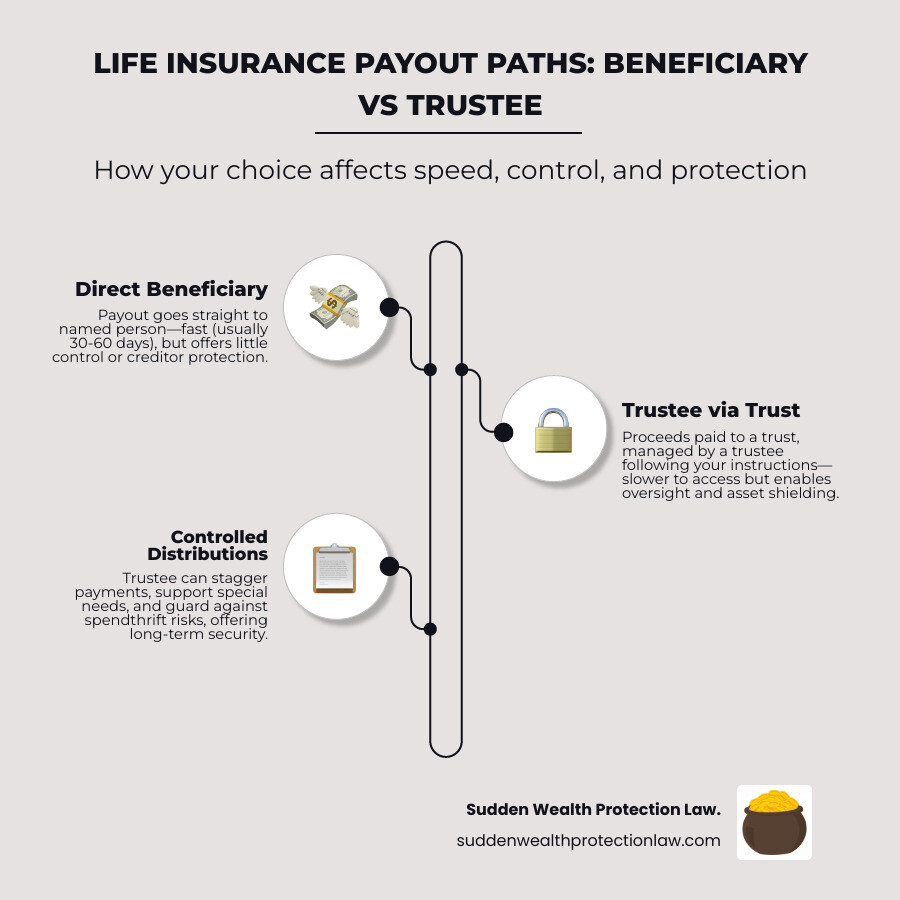
When the policy pays out, you have two delivery routes: hand the check to a person (beneficiary) or funnel it through a trust (trustee). One is fast but fragile; the other is slower but armored.
Direct Beneficiary
- Check arrives in 30–60 days.
- No strings attached once it clears.
- Open season for creditors, ex-spouses, and bad habits.
Trustee/Trust
- Funds hit a trust; trustee parcels money out per your playbook.
- A few extra weeks up front, but years of control and other safeguards after.
- Strong shield against creditors and estate-tax creep.
Most Arizona families pick the first door and regret it later. The moment you die, control dies with you. Your widow remarries, your kid turns 18, a lawsuit lands—your payout becomes collateral damage.
A trust rewrites that script. The trustee is legally bound to your instructions: tuition before Teslas, therapy before Vegas. I’ve spent 25 years watching families lose and save fortunes on this single decision.
Further reading:
- can a trustee be a beneficiary of the trust
- discretionary beneficiary vs final beneficiary
- income beneficiary vs principal beneficiary
Beneficiary vs Trustee for Life Insurance
Choosing between an individual beneficiary and a trust is really choosing between speed and control.
A beneficiary collects, pockets, and proceeds. A trustee collects, manages, and must obey your written marching orders.
| Feature | Direct Beneficiary | Trust (Trustee) |
|---|---|---|
| Payout Speed | 30–60 days | Slight delay for paperwork |
| Post-Payout Control | None | You set the rules |
| Fiduciary Duty | Not applicable | Trustee owes legal duty to all beneficiaries (A.R.S. 14-10801) |
| Creditor Protection | Weak | Strong (spendthrift provisions) |
| Estate-Tax Planning | Limited | ILIT/Asset Vault Trust can remove proceeds from taxable estate |
| Minors/Special Needs | Court must step in | Trustee handles—no probate, no lost benefits |
Quick Definitions
Beneficiary – the named recipient on the policy. Once paid, money is theirs.
Trustee – the manager of a trust that you name as beneficiary. They’re a fiduciary quarterback, bound to play your playbook.
Who Holds the Power?
While you’re alive, you (the policy owner) can change beneficiaries or switch trustees on a revocable trust. After you’re gone, the trust’s terms rule and the trustee’s neck is on the legal chopping block if they deviate.
When an Individual Beneficiary Makes Sense
Sometimes simple wins—mainly when your spouse needs immediate liquidity and you’re confident they won’t run the money off a cliff.
Advantages:
- Cash shows up fast for funeral costs, mortgage payments, or closing the business month.
- Proceeds skip your creditors while in transit.
But speed without guardrails courts disaster. Bolt these safeguards in place:
- Always add a contingent beneficiary. Primary dies with you? The contingent prevents probate detours.
- Avoid the Goodman Triangle. Keep two of the three roles (owner, insured, beneficiary) the same person to dodge gift-tax headaches.
- Never list minors or special-needs heirs directly. Courts, guardians, and benefit disqualification will torch half the money before adulthood.
- Don’t name your estate. That pulls the payout into probate—the very circus life insurance was meant to avoid.
When a Trust & Trustee Are the Smarter Move
If your goal is control, protection, or tax strategy, route the check to a trust.
Why Bother?
- Staggered distributions. Release funds at 21, 25, 30 (for example)—not 18 on a Friday night.
- Spendthrift shield. Creditors, ex-spouses, and lawsuit sharks can’t pierce a properly drafted Arizona trust with spendthrift language.
- Estate-tax relief. An Irrevocable Life Insurance Trust (ILIT) or Asset Vault Trust removes proceeds from the taxable estate if set up early enough.
- Prudent investing. Trustees must follow Arizona’s Prudent Investor Rule (A.R.S. 14-10901)—diversify, document, and act like a pro.
Revocable Living Trust as Beneficiary
Good for integrated planning and probate avoidance. You keep the wheel while alive and your successor trustee takes over when you’re gone. No estate-tax break, but no court either.
Irrevocable Life Insurance Trust (ILIT) & Asset Vault Trust
Heavy artillery for larger estates or creditor worries.
- Three-year rule. Policy must be owned by the ILIT at least three years before death to stay outside the estate.
- Gift-tax savvy. Use annual exclusion gifts to pay premiums.
- Asset Vault Trust (a 541 Trust). Same estate-tax muscle as an ILIT, but with a built-in special power of appointment that lets future generations tweak beneficiaries without cracking the armor.
Coordinating Roles & Staying Out of Court
Even the best documents implode when the fine print doesn’t match. Conduct a beneficiary-designation audit: every policy, every account, exact trust name, no typos.
Pick the Right Trustee
The job description: juggle money, family drama, and Arizona fiduciary law without dropping any of them. If no relative fits, hire a professional trustee and pay the fee—it’s cheaper than a family war.
Use HEMS as Your Guardrail
Tie discretionary distributions to Health, Education, Maintenance, or Support. Clear enough for a trustee to follow; flexible enough for real life.
Keep Everyone Informed
Arizona’s duty to inform (A.R.S. 14-10812) forces trustees to send annual reports. Done right, transparency kills lawsuits before they hatch.
Update After Life Changes
Divorce, remarriage, new baby, asset growth, or death of a listed party—every one of these should trigger an immediate beneficiary and trust review.
Frequently Asked Questions about Beneficiary vs Trustee for Life Insurance
Who can change a life-insurance trustee or beneficiary?
The policy owner rules beneficiary changes. For revocable trusts, you can swap trustees anytime. Irrevocable trusts need built-in removal clauses or a court order.
Does naming a trust slow the payout?
Yes—by weeks, not months. That short lag buys decades of protection, so call it a trade-up, not a drawback.
Can the same person be both trustee and beneficiary?
Yes, but they must put the trust’s interests above their own. HEMS language and co-trustees help keep temptation in check.
Conclusion
Handing an heir a lump-sum check is like leaving the keys to a Corvette on the kitchen table—fun until it wraps around a light pole. Routing life-insurance proceeds through a trust installs airbags, seatbelts, and a sober driver.
Control the money from beyond the grave, sidestep probate, and shield your legacy with an ILIT or, when creditor protection matters, an Asset Vault Trust.
Ready to lock in that control? Protect your life-insurance proceeds today.

